Specifying OEM sticky insect board for tea gardens for Wholesale and OEM Orders
How It Performs in Use
| Failure Mode | Root Cause | Specification Lever |
|---|---|---|
| Adhesive dries out before season ends | Low-cohesion hot-melt loses tack above 35 °C | Switch to UV-stabilised solvent acrylic at 45 g/m² coat weight |
| Board warps, adhesive transfers to foliage | Thin PP substrate (0.3 mm) absorbs moisture unevenly | Spec 0.5 mm co-extruded PE/PP with moisture barrier layer |
| Yellow fades to pale cream in 3 weeks | Standard pigment load 1.5 % without UV package | Masterbatch at 3 % + 0.5 % HALS; ΔE < 3 after 1,000 h QUV |
| Low catch counts despite high pest pressure | Spectral peak at 560 nm misses tea mosquito spectral sensitivity | Shift peak to 520–540 nm; add UV-reflective topcoat |
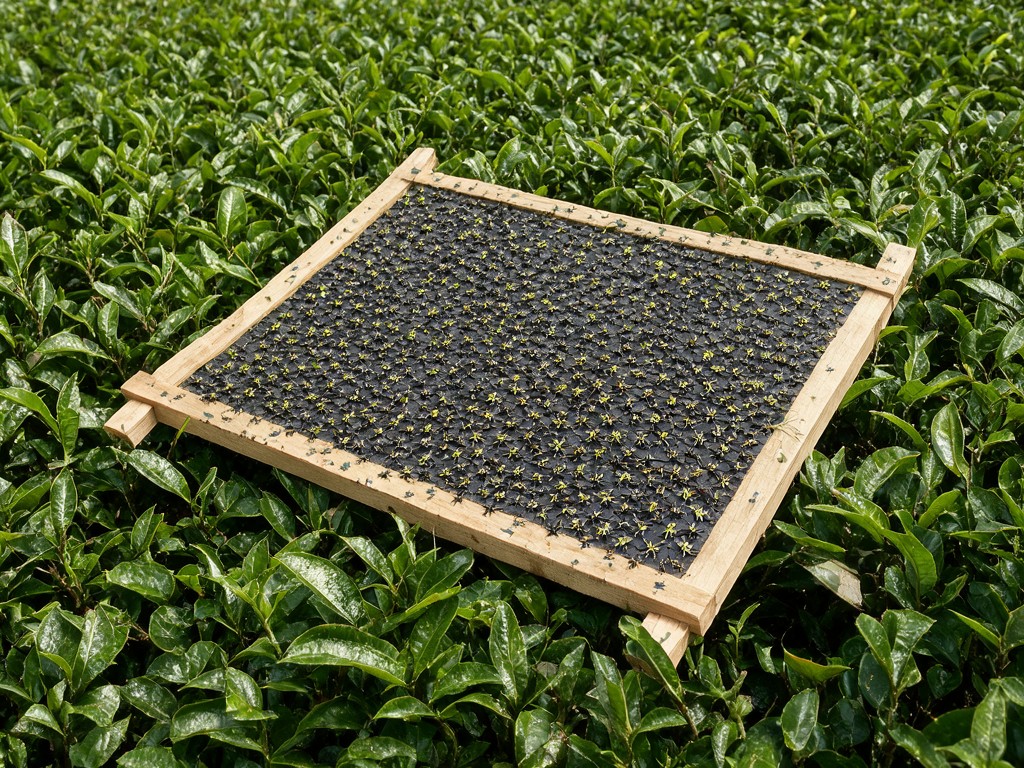
Tea gardens expose boards to monsoon humidity, 40 °C canopy temperatures, and intense UV-B at elevation. A board that passes a 24-hour lab tack test will still fail in week three if the adhesive chemistry does not resist thermal oxidation. Buyers who specify only "yellow sticky board" get commodity-grade traps that last 10–14 days. Specifying coat weight, polymer base, and spectral reflectance moves the conversation from unit price to cost per hectare per season.
How It Is Built and What That Changes
Hot-Melt Coating Line
Roll-to-roll at 30 m/min. Adhesive applied at 160 °C through slot die. Coat weight control ±3 g/m². Release liner siliconised PET, 38 µm. Best for 20–30 g/m² coats where cost per board drives the decision.
Trade-off: limited UV package incorporation; adhesive softens above 38 °C. Not recommended for low-elevation gardens with sustained heat.
Solvent Acrylic Coating Line
Reverse gravure at 15 m/min. Solvent evaporation in 4-zone oven. Coat weight 35–60 g/m² ±2 g/m². Release liner kraft paper, 80 gsm. Allows HALS, UV absorbers, and spectral pigments directly in adhesive matrix.
Trade-off: 25 % higher coating cost, 2-day longer cure before slitting. Required for 60+ day field life at 1,200 m elevation.
Substrate extrusion runs separate from coating. We hold 0.5 mm co-extruded PE/PP in stock (natural and pre-pigmented yellow). Thinner 0.3 mm monolayer PP is available but only for promotional-grade orders where seasonal replacement is planned. Die-cutting registers to ±0.3 mm; hole-punch for twist-tie or stake mount adds one station. Every roll passes inline optical inspection for coating voids >2 mm before palletising.
Specification Range and Customisation Limits
Hard Limits
Board dimensions: 150 × 200 mm to 300 × 450 mm. Outside this range requires new die tooling (4-week lead, $1,200).
Adhesive coat weight: 20–60 g/m². Below 20 g/m² catches drop 40 %; above 60 g/m² causes blocking in stack.
Spectral peak: 500–580 nm achievable. Narrower peaks (±10 nm) need custom masterbatch (MOQ 5 t substrate).
Standard grid: 25 mm square printed in UV-resistant black ink. Grid aids count surveys but adds $0.008/board. Omit for export markets where regulatory labelling replaces count grids. Thickness tolerance ±0.05 mm on 0.5 mm substrate; ±0.03 mm on 0.3 mm. Weight per board: 8.2 g (0.3 mm, 20 g/m²) to 18.5 g (0.5 mm, 60 g/m²). Pack count per carton fixed at 500 boards to maintain stack height under 180 mm for pallet stability.
What Can Be Customised and What Cannot
Customisable: substrate colour (yellow, blue, white), adhesive chemistry (hot-melt vs solvent acrylic), coat weight, grid print, branding overprint (single colour, 150 × 50 mm max), release liner type (PET vs kraft), pack count (250, 500, 1,000), carton labelling language.
Not customisable: board shape (rectangular only), multi-colour printing, adhesive pattern coating, substrate thickness outside 0.3/0.5 mm, individual board barcoding. A buyer requesting die-cut circles for canopy suspension must accept 6-week tooling and 50,000 board MOQ. We quote those as separate project, not catalogue line.
Capacity, Tooling and Scheduling
Coating capacity: 1.2 million boards/month on solvent line, 2.5 million on hot-melt. Die-cutting runs 200,000 boards/shift. Standard yellow 0.5 mm / 45 g/m² solvent acrylic holds 400,000 boards in semi-finished inventory (substrate slit, adhesive coated, release liner applied). Final die-cut and pack adds 3 days.
New substrate colour or coat weight: 10-day minimum for masterbatch trial and coating validation. New die: 4 weeks. Peak season (March–May) runs at 95 % capacity; orders placed after January 15 ship July at earliest. Off-season (October–December) offers 3-week lead on any catalogue spec. We hold safety stock of 200,000 standard boards for repeat buyers with blanket POs.
Keeping Repeat Orders Supplied
Blanket PO with monthly call-offs locks substrate and adhesive allocation. We commit to ±5 % shipment window once call-off received. Batch traceability: every carton carries QR code linking to coating lot, substrate roll, QUV test report, and adhesive rheology log. If a buyer reports catch-rate drop, we pull the coating lot sample from retention (held 18 months) and run comparative field trial at our partner estate in Munnar. Root cause typically traces to adhesive coat weight drift >±4 g/m² or pigment batch variance. Corrective action: adjust gravure cylinder depth or masterbatch let-down ratio; updated spec sheet issued within 48 hours.
Export Packaging and Handling Protection
Carton: 5-ply BC flute, 400 × 300 × 180 mm, 500 boards flat-stacked. Gross weight 9.8–11.2 kg depending on spec. Pallet: 48 cartons (24,000 boards) on 1,100 × 1,100 mm heat-treated pine, stretch-wrapped with UV-opaque black film. Container loading: 20 pallets per 40' HC (480,000 boards). Desiccant sachets (2 per carton) for shipments >21 days transit. Temperature logger included in every 5th pallet for solvent acrylic grades; data reviewed on arrival. No stacking double-high in warehouse — adhesive blocking risk above 30 °C ambient.
Questions Buyers Ask Before Ordering
- What is the minimum order for a custom spectral peak? 5 tonnes substrate (≈400,000 boards at 0.5 mm). Masterbatch trial takes 10 days; we send 500 test boards for field validation before full run.
- Can you supply boards pre-baited with pheromone lure? No. Adhesive chemistry interferes with lure release kinetics. We supply lure clips separately; buyer applies at field deployment.
- How do you guarantee catch-rate consistency across batches? Coating rheology logged every 15 minutes. Spectral reflectance measured on 1 in 500 boards. Field validation at partner estate every coating lot. Data shared under NDA.
- What happens if boards arrive with adhesive transfer? Claim with photos and lot code within 14 days. We replace at 1.5× quantity next shipment. Root cause usually transit temperature >40 °C; we then mandate refrigerated container for that lane.
- Do you offer biodegradable substrate? PLA/PBAT blend available at 0.5 mm, 30 % cost premium, 18-month shelf life. Not compostable in tea garden soil — requires industrial facility. Most buyers stay with PE/PP for cost and durability.
Request a Quotation Review
Send your specification sheet — target pest, elevation, season length, and annual volume. We return a marked-up spec with coil allocation, lead time, and landed cost per hectare within 24 hours.
Start Quotation Review


