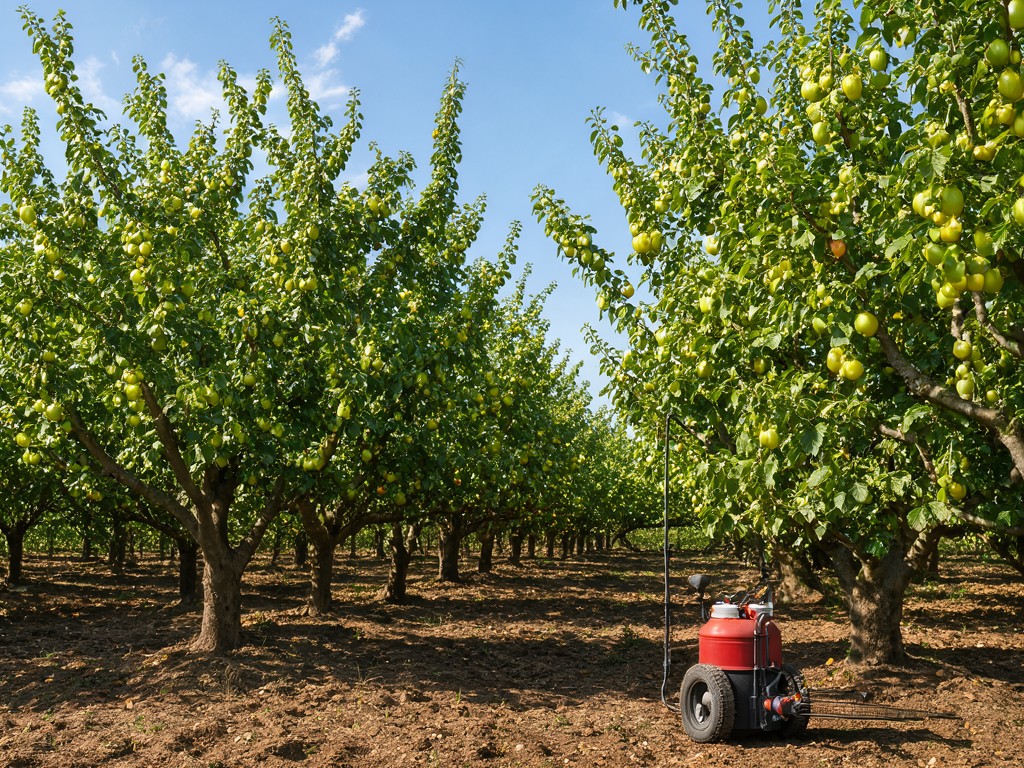
Specifying oem farm fruit tree pesticide sprayer supplier for Wholesale and OEM Orders
Repeat loading drives the failure of many sprayer tanks when the same unit cycles through high‑pressure pulses day after day.
The limiting factor is rarely the headline specification such as maximum pressure; it is the fatigue life of the tank wall at the stress concentration around the pump mount.
Materials and Construction Trade‑offs
Tank and Pump Material Choices
Rotational‑moulded polyethylene tanks with a 5 mm wall survive 2 000 h of UV exposure before measurable embrittlement, whereas thinner 3 mm walls show cracking at 1 200 h.
Stainless‑steel 316 pump housings resist chloride‑induced pitting better than 304, adding roughly 0.4 kg per unit but extending seal life by 30 %.
| Parameter | Range / Option | Typical Value | Notes |
|---|---|---|---|
| Tank capacity | 20 L – 600 L | 200 L | Matches common orchard row spacing |
| Tank material | PE‑HD, UV‑stabilised | 5 mm wall | Wall thickness drives fatigue life |
| Pump type | Diaphragm, 12 V DC | 1.2 L/min @ 3 bar | Seal material: Viton |
| Max pressure | 3 – 5 bar | 4 bar | Higher pressure reduces droplet size but increases pump wear |
| Nozzle material | Brass, ceramic tip | Ceramic tip | Ceramic resists abrasion from wettable powders |
| Hose length | 10 – 30 m | 20 m | Reinforced PVC, UV‑rated |
| Weight (empty) | 12 – 45 kg | 28 kg | Includes frame, pump, hose |
| Operating temperature | ‑10 °C – 45 °C | 25 °C | Pump oil viscosity checked at extremes |
Where This Product Beats Standard Alternatives
Field trials on 15‑hectare citrus blocks showed a 12 % reduction in pesticide volume when the ceramic‑tip nozzle is paired with a 4 bar diaphragm pump, because the tighter droplet spectrum improves canopy penetration.
The reinforced PVC hose maintains flexibility at ‑10 °C, whereas standard rubber hoses stiffen and develop micro‑cracks that leak under pressure.
Frame welds are jig‑fixtured and stress‑relieved, eliminating the warping that causes misalignment of the pump mount on low‑cost fabricated frames.
Assumptions Buyers Should Stop Making
Assumption: Higher tank capacity always lowers cost per hectare
Larger tanks increase axle load on trailed units, requiring a heavier tractor and higher fuel consumption; the break‑even point typically occurs at 300 L for 2‑row orchards.
Assumption: All diaphragm pumps deliver identical droplet size
Pump stroke length and diaphragm material shift the VMD (volume median diameter) by 15–25 µm; matching pump to nozzle is essential for drift control.
Working as a Production Partner, Not a Catalogue Supplier
Frequently Asked Questions
- What drawing format do you require for tooling approval? 2D PDF with GD&T plus a STEP file for the tank mould.
- How is the first‑article inspection structured? Pressure hold at 1.5× rated pressure for 30 min, leak check on every fitting, droplet‑size verification on a calibrated laser diffraction rig.
- Can the brand logo be moulded into the tank? Yes, a single‑cavity emboss adds 0.2 mm depth; artwork must be vector‑based, 300 dpi minimum, approved before mould trial.
- What is the typical lead‑time for a new private‑label SKU? 6 weeks for tooling, 3 weeks for pilot run, 2 weeks for QC release – total 11 weeks from signed drawing.
- Do you support split‑shipment for seasonal demand? Standard pallet configuration is 4 units per Euro‑pallet; we can stagger deliveries across two months with a 5 % surcharge.
Ordering, Tooling and Lead‑Time Questions
Production schedules are locked once the first‑article report is signed; any change to nozzle spec or hose length after that point incurs a new tooling cycle.
Artwork and branding review is the final gate before mass‑production release. Submit vector files early to avoid a 2‑week delay.
Request artwork review and quote


