custom farm physical pest control sticky trap supplier: Specification, Ordering and Quality Notes
Where Cheaper Alternatives Fall Short
| Parameter | Budget-Grade Trap | Specification-Grade Trap | Cost Impact per Hectare |
|---|---|---|---|
| Adhesive life at 35 °C / 80 % RH | 3-5 days before 40 % tack loss | 14-21 days at > 80 % initial tack | 2-3× fewer trap replacements |
| UV resistance (QUV 340 nm, 500 h) | Substrate yellows, adhesive cracks | < 5 % tensile loss, no adhesive chalking | Eliminates mid-season swap-outs |
| Dust loading capacity | Saturates at 0.8 g/m² | 2.5 g/m² before capture rate drops | Critical in dusty row-crop conditions |
| Lure retention (pheromone, 30 °C) | 7-10 days to 50 % emission | 21-28 days to 50 % emission | Fewer lure cartridges per season |
Procurement officers who specify solely on unit price find that budget traps require 2.3× more field visits per growing season. The extra labour, fuel, and lure cartridges push total cost of ownership 35-50 % above the specification-grade alternative. First-article tooling determines whether the adhesive coat weight stays within ± 3 g/m² across the full web width — a tolerance that budget coaters rarely hold.
Design Constraints Behind the Specification
The build method decides every downstream failure mode. Substrate choice locks in dimensional stability: 125 µm polyester holds flat within ± 0.3 mm/m at 90 % RH, while 150 gsm coated paper can cockle 1.2 mm/m, causing adhesive bridging at the fold line of tent traps. Adhesive chemistry is the next gate — hot-melt rubber/resin blends deliver 1,200 g/cm² loop tack but soften above 40 °C; water-based acrylics hold 850 g/cm² down to -10 °C and resist 60 °C without oiling. We run both systems on the same coating line; the switch adds 45 minutes of purge time but lets a single PO cover cool-season monitoring and peak-summer mass trapping.
Release liner peel force must sit between 15-35 g/25 mm. Below 15 g, liners lift in transit; above 35 g, field workers tear the trap face when deploying. Silicone coat weight on the liner is controlled to 1.1 ± 0.1 g/m² — tighter than the industry norm of ± 0.3 g/m² — because private-label brands report liner-tear complaints as their top return reason. Die-cut registration holds ± 0.15 mm on the rotary tool; anything looser misaligns the lure well, creating a 2 mm gap where target pests escape.
What Can Be Customised and What Cannot
Customisation lives in the converting stage, not the coating stage. Once the adhesive web is cured, its rheology is fixed — you cannot dial tack up for whitefly and down for thrips on the same roll. What can change per SKU:
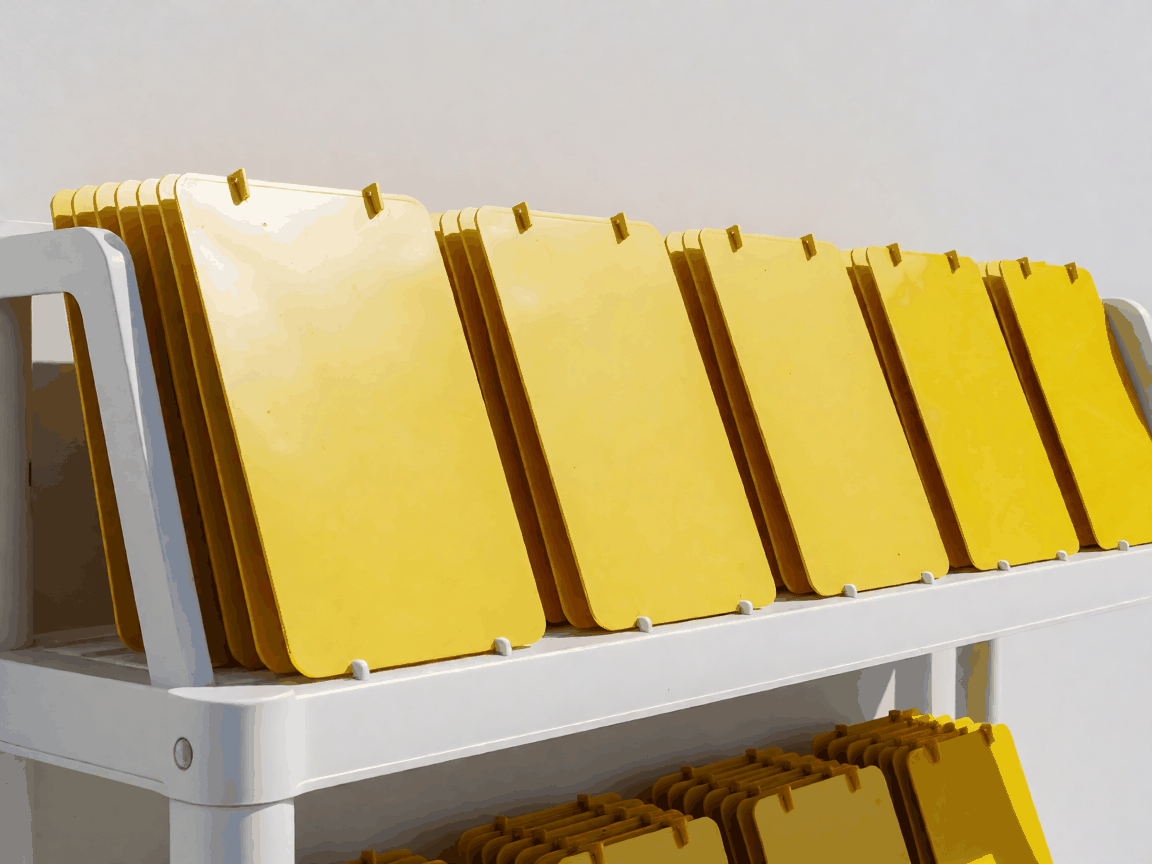
- Trap geometry: flat card (100 × 150 mm), folded tent (200 × 150 mm folded), delta trap (120 × 100 × 80 mm), or continuous roll (300 mm × 100 m)
- Colour: yellow (560 nm peak) for whitefly/aphid, blue (450 nm) for thrips, white for beet armyworm, black for stored-product beetles
- Print: grid lines (5 mm spacing), QR-coded batch ID, private-label logo, crop-specific instructions
- Lure well: moulded pocket (holds rubber septum), punched hole (holds vial), or adhesive dot (holds membrane lure)
- Packaging: bulk poly-bagged (500 pcs), retail clamshell (10 pcs), or dispenser box (100 pcs with tear strip)
Hot-Melt Adhesive Path
Coats at 165 °C, 35 g/m² ± 3 g/m²
Tack: 1,200 g/cm² (loop tack)
Shear: 48 h @ 1 kg/25 mm @ 40 °C
Best for: cool-season monitoring, short-duration mass trapping
Water-Based Acrylic Path
Coats at 40 % solids, 32 g/m² dry ± 2 g/m²
Tack: 850 g/cm² (loop tack)
Shear: 120 h @ 1 kg/25 mm @ 60 °C
Best for: tropical/subtropical season-long deployment
What cannot change without new tooling: substrate gauge, adhesive chemistry, liner type, or die-cut profile. Each new die costs $1,200-$2,800 and adds 10 working days to first-article approval. Private-label buyers typically amortise die cost over 500,000 traps; below that volume, standard geometries are the only economical route.
Who Uses It and Where It Matters
Large-scale vegetable growers (200+ ha) running IPM programmes need traps that survive 21-day scout intervals without adhesive failure. They order yellow tent traps by the 50,000-unit pallet, labelled with field-block QR codes for digital scouting platforms. Citrus cooperatives in Mediterranean climates specify blue delta traps with acrylic adhesive — they hang March through November and cannot tolerate mid-season adhesive oiling onto fruit. Stored-grain facilities use black flat cards in grain bins; the traps must hold tack at 15 % grain moisture and 30 °C for six months. Each segment demands a different adhesive/substrate/geometry combination, but all share the same quality gate: zero liner-tear complaints per 100,000 traps deployed.
OEM and ODM Programme Structure
OEM orders run on our standard adhesive/substrate platforms with your artwork and packaging. Minimum 50,000 traps per SKU, 12-week lead from artwork approval to first pallet. ODM projects — new geometry, new adhesive formulation, or integrated lure dispenser — require a joint development agreement. We split tooling 50/50, you get 18-month exclusivity on the design, and we retain freedom to sell the base adhesive platform to other customers. Typical ODM timeline: 8 weeks for adhesive trial coating, 6 weeks for die development, 4 weeks for accelerated aging (QUV 1,000 h + 40 °C/75 % RH 21 days), then 3 weeks for field validation in your target crop. First commercial run ships week 21 from signed JDA.
How Consistency Is Held Across Batches
Consistency is set at the forming stage. Every coating run starts with a 50 m warm-up web that is scrapped — this stabilises die temperature and adhesive flow before the first saleable metre. In-line sensors track coat weight (beta backscatter), web tension (± 0.5 N), and oven zone temperatures (± 1 °C). Data logs are archived per roll for 24 months. Converting shifts run a first-piece inspection: 10 traps measured for dimensions, adhesive coat weight (gravimetric), liner peel force, and die-cut registration. If any parameter drifts outside spec, the shift stops, root cause is logged, and the affected roll is quarantined. Batch release requires CpK ≥ 1.33 on all critical-to-quality characteristics. Private-label customers receive the CpK summary with every shipment; we do not release certificates of analysis — the process data is the certificate.
Inspection Items and Test Methods
| Test | Method | Acceptance Criteria | Frequency |
|---|---|---|---|
| Loop tack | ASTM D6195 (modified 25 mm probe) | Hot-melt: 1,200 ± 150 g/cm²; Acrylic: 850 ± 100 g/cm² | Every coating lot |
| Shear adhesion failure temperature (SAFT) | ASTM D4498, 1 kg/25 mm, 1 °C/min ramp | Hot-melt ≥ 48 °C; Acrylic ≥ 72 °C | Every coating lot |
| UV accelerated aging | QUV 340 nm, 0.89 W/m², 8 h UV / 4 h condensation @ 50 °C | Tack retention ≥ 80 % after 500 h; no substrate chalking | Quarterly per adhesive platform |
| Humidity cycling | 12 cycles: 2 h @ 40 °C/90 % RH → 2 h @ -10 °C | No liner pick, no adhesive transfer, dimensional change ≤ 0.5 % | Quarterly per substrate |
| Field capture equivalence | Paired trap comparison, 10 replicates, 7-day exposure | Test trap catch ≥ 95 % of reference trap catch (p > 0.05) | Every new geometry/lure well design |
We do not run salt-spray or abrasion tests — they do not correlate with field failure modes for this product. The two failure modes that drive returns are liner tear (peel force drift) and premature tack loss (SAFT drift). Our inspection plan targets those two with 100 % lot testing on the coating line and quarterly accelerated aging on the platform.
Capacity, Tooling and Scheduling
Coating capacity: 1.2 million m²/month across two lines (one hot-melt, one water-based). Converting capacity: 8 million traps/month on three rotary die-cutters and two flatbed folders. Standard geometries (yellow tent, blue delta, white flat) carry standing die inventory — zero tooling lead time. Custom dies: 10 working days from approved drawing to first article. Seasonal demand peaks January-March (Southern Hemisphere) and May-July (Northern Hemisphere); we hold 30 % safety stock on standard SKUs during those windows. Private-label orders placed outside peak windows lock in 8-week lead time; peak-window orders stretch to 12-14 weeks unless buffer stock is pre-positioned. FOB Shanghai or EXW factory; we arrange export palletisation (ISPM-15 compliant) and can drop-ship to up to three destination ports per PO.
Next Steps
Request a sample pack with both adhesive platforms, your target geometries, and the standard lure wells for your crop. We ship DDP to your QA lab within 5 working days of artwork approval for standard items. For ODM enquiries, share the target pest, crop calendar, and climate zone — we return a feasibility memo with adhesive recommendation, tooling estimate, and timeline within 48 hours.



