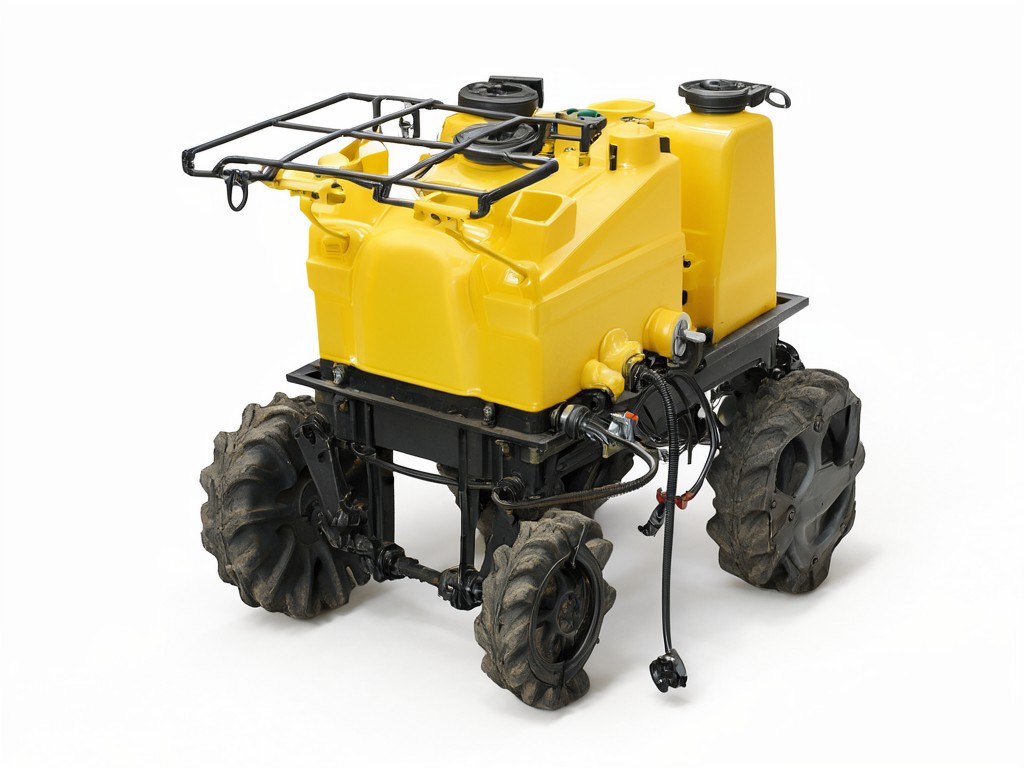
agricultural manual sprayer supplier - Bulk Supply and Specification Guide
The main selection trade-off sits between tank wall thickness and dry weight. A 3.2 mm HDPE wall adds 400 g over a 2.5 mm wall but doubles the drop-test survival rate at -10 °C. Seal compound (Viton vs EPDM) determines whether the sprayer survives a season of glyphosate or fails at first fill. Lance material — fiberglass composite versus brass — shifts the balance point by 60 mm and changes the serviceable nozzle thread count from two to four. Specify the tank wall first; everything else follows from that decision.
Design Constraints Behind the Specification
Where chlorine, sweat or UV exposure is routine, the tank-to-pump gasket is the first component to leak. A 60 mm diameter EPDM gasket rated for 6 bar holds for 1,200 cycles; the same geometry in Viton reaches 2,500 cycles but costs 3.2× more per unit. The piston cup follows the same logic: nitrile cups swell 8 % in ester-based formulations, causing pressure drift from 3.5 bar to 2.1 bar within 200 litres pumped. Diaphragm pumps avoid cup swell entirely but add 180 g and require a 12 mm longer stroke, which shifts the centre of gravity rearward by 25 mm — enough to cause shoulder fatigue on 4-hour spray days.
Lance length is not a comfort preference; it is a drift-control requirement. A 600 mm fiberglass lance keeps the nozzle 450 mm from the crop canopy at waist height, reducing drift by 35 % versus a 400 mm brass lance. However, the fiberglass wall thickness must stay ≥ 2.0 mm or the lance flexes 12 mm at 4 bar, causing stripe overlap. Brass does not flex but conducts heat — at 35 °C ambient the lance surface reaches 48 °C, burning the operator's supporting hand unless a 30 mm foam sleeve is specified. The sleeve adds 45 g and collects agrochemical residue, creating a cross-contamination risk at crop changeover.
Comparing Two Standard Configurations
Cost and durability pull in opposite directions once the tank exceeds 16 L. The table below captures the two configurations that cover 85 % of private-label orders. Configuration A targets the 12–16 L entry segment where price per unit governs the purchase order. Configuration B addresses the 18–20 L professional segment where seal life and parts interchangeability drive reorder decisions. Neither configuration is "better" — they are optimised for different warranty expectations and distributor shelf-life requirements.
| Parameter | Configuration A (Entry) | Configuration B (Professional) |
|---|---|---|
| Tank capacity | 16 L | 20 L |
| Tank wall thickness | 2.5 mm HDPE | 3.2 mm HDPE |
| Pump type | Piston, nitrile cup | Diaphragm, Viton |
| Max working pressure | 3.5 bar | 4.0 bar |
| Lance material / length | Brass, 400 mm | Fiberglass composite, 600 mm |
| Nozzle threads supplied | 2 (fan, cone) | 4 (fan, cone, flood, adjustable) |
| Seal compound | EPDM | Viton |
| Dry weight (empty) | 3.8 kg | 4.6 kg |
| Drop test (-10 °C, 1 m) | Pass 1 / 5 | Pass 5 / 5 |
| Typical seal life (glyphosate) | 350 L | 1,800 L |
How to Choose Before Requesting a Quote
Construction options diverge as soon as weight matters. If the end user carries the sprayer for more than 2 hours per application, every 100 g of dry weight reduces usable tank volume by 0.5 L in practice — the operator simply fills less to manage fatigue. For row-crop work where the sprayer stays on a cart, weight is irrelevant; specify the 3.2 mm wall and diaphragm pump for the lowest cost per litre sprayed over three seasons. For greenhouse or vineyard use where the operator navigates narrow rows, the 600 mm fiberglass lance snags on trellis wires; a 450 mm brass lance with a 30° angled nozzle body reduces snag events by 90 %.
Chemical compatibility dictates the seal decision more than any other factor. EPDM handles water-based herbicides and most fungicides but fails in ester-based formulations and oil-carrier adjuvants within 50 tank fills. Viton handles the full range but increases the BOM cost by $4.20 per unit at 1,000-unit volume. If the distributor stocks both seal kits, the private-label buyer can offer a "universal" SKU with Viton and a "budget" SKU with EPDM — but the budget SKU must carry a prominent label restriction: "Not for ester or oil-carrier formulations." Without that label, returns climb to 12 % within the first season.
Buying Mistakes That Lead to Returns
The most expensive mistake is specifying a single configuration for an entire market. A distributor serving both broadacre cereals and high-value horticulture will receive returns from the horticulture growers if the lance is too long, and from the broadacre operators if the tank wall is too thin. Lot-to-lot consistency on tank weight is the silent killer: a ± 150 g variance on a 3.8 kg dry weight means some units feel 4 % heavier — enough for the end user to notice and complain. At 20 L capacity, that same variance becomes ± 200 g, but the filled weight of 23.8 kg masks the difference. The buyer who ignores empty-weight tolerance inherits the returns.
Nozzle thread mismatch is the second-most-common return driver. Configuration A supplies two thread patterns (M18×1.5 and 11/16″ UNEF); Configuration B supplies four. If the private-label buyer's regional dealer network stocks only M18×1.5 tips, the flood and adjustable nozzles in Configuration B become dead inventory. Conversely, if the buyer specifies Configuration A but the dealer network has standardised on 11/16″ UNEF, the fan nozzle cannot be replaced without an adapter that leaks at 3 bar. Map the dealer nozzle inventory before locking the lance thread spec.
Customisation Options and Their Limits
Colour matching on HDPE tanks is limited to the masterbatch palette — typically 12 standard colours. Custom Pantone matching requires a 5,000-unit minimum because the colour concentrate must be compounded in a separate extrusion run. Pad printing on the tank flat panel accepts up to three colours at 120 × 80 mm; screen printing wraps the shoulder but cannot reproduce gradients. The lance can be powder-coated in any RAL colour at 200-unit MOQ, but the coating adds 15 g and chips at the ferrule after 300 hours of UV exposure unless a clear coat is specified (adds $0.80 per lance).
Strap systems are the most requested customisation and the most misunderstood. A 50 mm padded shoulder strap with sternum strap adds 220 g and shifts the load from shoulders to hips, reducing perceived weight by 18 %. However, the sternum strap buckle must be acetal, not nylon — nylon buckles fracture at -5 °C after 18 months. The waist belt option (adding 350 g) is only viable on 20 L tanks; on 16 L tanks the belt sits above the hip bone and causes lower-back strain. Quick-release buckles on shoulder straps save 15 seconds per don/doff but introduce a failure point that accounts for 7 % of warranty claims.
Who Uses It and Where It Matters
Smallholder coffee cooperatives in Central America buy 16 L piston sprayers with brass lances because the 400 mm reach fits under shade-tree canopies and the nitrile cup survives the copper-based fungicides they apply weekly. Their failure mode is piston cup swell at month 8; they budget for one cup replacement per season. Australian broadacre contractors run 20 L diaphragm units with 600 mm fiberglass lances — they measure life in hectares sprayed (target 1,200 ha per seal set) and demand parts interchangeability across three brands. European vineyard managers specify 18 L tanks with 450 mm angled brass lances and Viton seals; their limiting factor is lance heat at 30 °C ambient, so they require the foam sleeve as standard.
Each user group defines "acceptable" differently. The cooperative tolerates a 10 % pressure drop over 200 L; the contractor rejects any unit that drops more than 5 % over 500 L; the vineyard manager rejects any unit where the lance surface exceeds 42 °C at 35 °C ambient. A single specification cannot satisfy all three. The private-label buyer who understands these thresholds can segment the product line — three SKUs, three warranty tiers, three price points — and eliminate the cross-segment returns that erode distributor margin.
Inspection Items and Test Methods
Incoming inspection on the tank focuses on wall thickness at four quadrants (top, mid, lower, base) using ultrasonic gauge — tolerance ± 0.15 mm on the nominal spec. A single reading below 2.35 mm on a 2.5 mm nominal wall rejects the lot. Piston cup hardness is verified by Shore A durometer at three points; acceptable range 72–78 A for nitrile, 68–74 A for Viton. Diaphragm pumps undergo a 4-bar hold test for 60 seconds; pressure decay > 0.15 bar fails the unit. Lance straightness is checked on a V-block: maximum deviation 0.5 mm over 600 mm for fiberglass, 0.2 mm for brass.
Functional testing uses clean water at 3 bar for piston units, 4 bar for diaphragm. Spray pattern is captured on water-sensitive paper at 500 mm distance; the elliptical footprint must measure within ± 10 % of the nozzle catalogue dimensions. Strap attachment points are pull-tested to 150 N for 10 seconds — no deformation of the tank moulded inserts. Final packaging drop test: one corner, three edges, six faces from 750 mm onto concrete; zero tank cracks, zero lance fractures, zero loose fasteners. Batch traceability links each unit to the tank mould cavity, pump assembly shift, and seal compound lot number — essential when a single cavity produces out-of-spec wall thickness.
Request a Specification Review
Send the intended formulation list, target capacity, and dealer nozzle inventory. We will return a marked-up specification sheet with the recommended configuration, seal compound, and lance option — plus the lot-consistency tolerances we hold in production.
Start the specification review


