wholesale household and commercial sticky pest traps supplier - Bulk Supply and Specification Guide
What the Design Has to Balance
Returns usually trace back to the same weak point: adhesive that either fails to hold target insects or transfers onto the release liner during storage. A trap destined for a humid kitchen in Singapore needs a different coat weight and carrier saturation than one headed for a dry warehouse in Arizona. The design brief always starts with the destination climate and the target species — German cockroaches demand a thinner, faster-grabbing film than stored-product beetles, which need deeper adhesive wells to prevent escape.
Substrate choice locks in the next set of trade-offs. Kraft-backed board absorbs adhesive differently than PE-coated card or rigid PP sheet. A 250 gsm kraft board with 40 g/m² hot-melt coat weight gives a rigid trap that lays flat on shelves but can curl at 60% RH if the backside isn't moisture-balanced. Switching to a 300 micron PP sheet eliminates curl but adds 15-20% to unit cost and changes the die-cutting tooling. The buyer's retail price point usually decides this before we ever cut a sample.
Specification rule: Coat weight tolerance must stay within ±3 g/m² lot-to-lot. Drift beyond this range changes the grab-to-hold ratio enough to trigger field complaints within the first 30 days of shelf life.
Attractant integration adds a third variable. Pheromone lures loaded into the adhesive matrix during coating degrade faster than those in separate sachets, but sachets add assembly steps and a second SKU to manage. Food-oil attractants in the adhesive itself survive 18 months at 25°C if the antioxidant package is dosed at 0.2% BHT, but that same dose can yellow the adhesive on white substrates — a cosmetic defect that gets rejected at incoming QC even when efficacy is unchanged.
How It Is Built and What That Changes
The complaint that repeats across reorders is almost always adhesive inconsistency — not the substrate, not the printing, not the packaging. Our coating line runs a slot-die head at 80 m/min with inline IR dryers for water-based formulations and chill rolls for hot melt. Coat weight is controlled by pump speed and die gap; a 0.05 mm gap shift changes deposit by 8-10 g/m². We lock the gap with shimmed feeler gauges at every product changeover and verify with beta backscatter gauges every 500 m of web.
Release liner siliconization is the silent failure mode. A 60 g/m² glassine liner with 0.8 g/m² silicone coat releases cleanly at 120-180 cN/25mm peel force. If the silicone batch runs 15% low, the liner tears on application. If it runs 15% high, the adhesive picks up liner fibers. We qualify each liner lot with a 5-strip T-peel test before it enters the coating cell — no exceptions.
| Usage Condition / Market | Typical Complaint or Failure | Preventive Specification |
|---|---|---|
| High humidity retail (SE Asia, Gulf) | Substrate curl > 15 mm; adhesive softening | PP/PET film substrate; hydrophobic adhesive; backside moisture barrier coat ≥ 8 g/m² |
| Cold-chain storage / winter freight | Adhesive embrittlement; liner release spike | Hot-melt formulation with ≥ 15% tackifier resin; SAFT ≥ 65°C; liner peel 100-150 cN/25mm at 5°C |
| Commercial kitchen / food prep zones | Grease contamination reduces catch; attractant wash-off | Oleophobic adhesive topcoat; encapsulated attractant ≥ 2% load; NSF-listed components |
| Long shelf-life private label (24+ months) | Adhesive yellowing; attractant degradation; liner blocking | UV stabilizer 0.3% + antioxidant 0.2%; pheromone in separate sachet; liner silicone 1.0 g/m² |
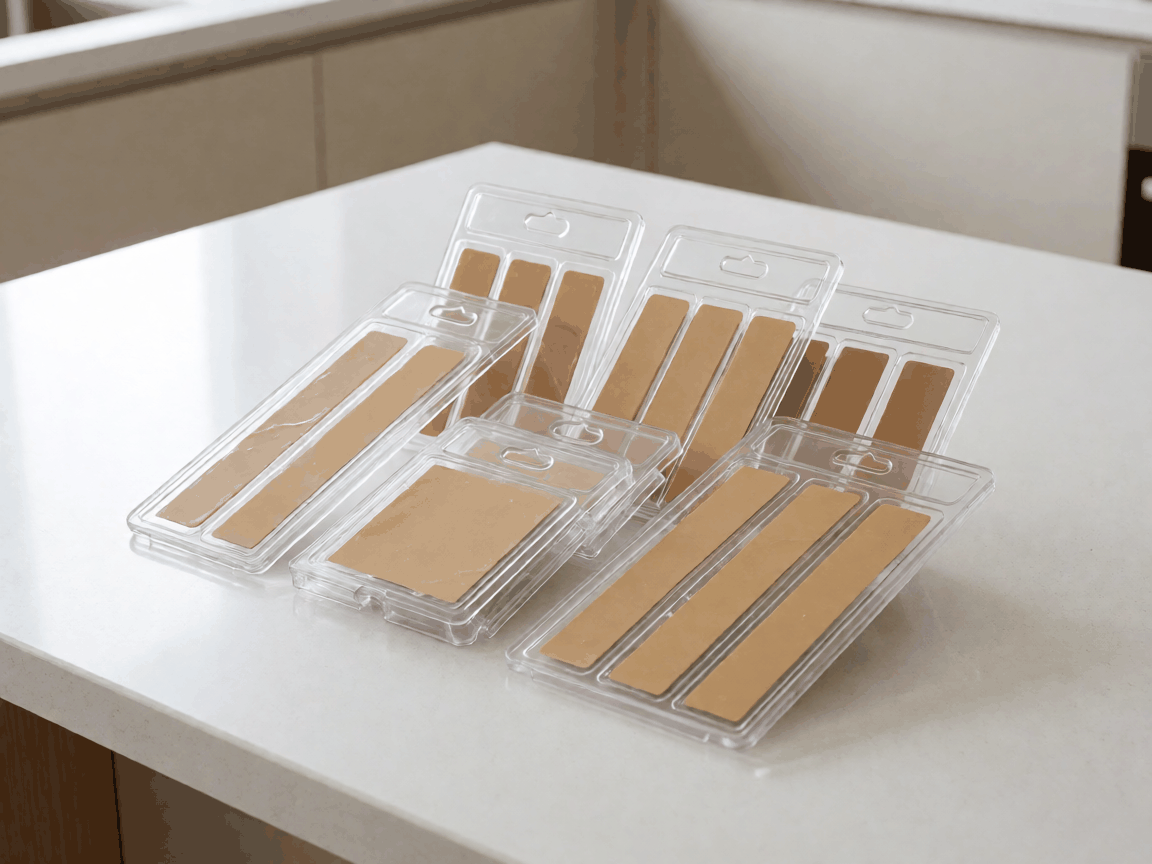
Die-cutting registers to ±0.3 mm on the rotary press. Registration drift beyond this creates traps with uneven adhesive margins — one edge grabs the liner, the other exposes adhesive to dust. We run a first-article optical check at 300 dpi on every new die set and re-verify after every 50,000 impressions. Tooling life on carbide dies averages 250,000 cuts on kraft, 400,000 on PP before burr formation affects release.
OEM and ODM Programme Structure
Private-label programmes start with a technical questionnaire: target species, deployment environment, retail pack format, regulatory market (EPA, PMRA, Biocidal Products Regulation), and brand artwork specs. We return a specification sheet with three adhesive formulation options, two substrate choices, and a cost ladder at 50k, 100k, and 250k unit MOQs. Tooling for custom die shapes runs 3-4 weeks; printing plates for branded release liners add another 10 working days.
ODM development follows a gated process. Gate 1: adhesive-substrate-attractant matrix screening on 500-piece pilot rolls. Gate 2: accelerated aging at 40°C/75% RH for 28 days plus field efficacy in two geographic zones. Gate 3: production validation run at 10,000 units with full Cpk ≥ 1.33 on coat weight, dimensions, and peel force. No design exits Gate 2 without passing both lab and field criteria — this is where most competitor programmes skip steps and later pay in returns.
Artwork approval uses a digital proofing workflow with Pantone spot verification on the actual substrate. We hold a master colour target for each brand; ΔE ≤ 2.0 on the trap body, ≤ 1.5 on the release liner print. Barcodes are verified to ISO/IEC 15416 Grade B or better before plates are cut. A single barcode failure on a retail-ready display carton costs more in chargebacks than the entire prepress budget.
Inspection Items and Test Methods
Incoming QC on raw materials covers adhesive rheology (Brookfield viscosity at 160°C for hot melt, 25°C for water-based), substrate basis weight and moisture content, liner silicone coat weight (gravimetric), and attractant GC-MS purity ≥ 97%. Every lot gets a certificate of analysis before it touches the coater.
In-process checks run every 30 minutes: coat weight via beta gauge, web width, adhesive temperature, dryer/chill roll temps, line speed. Data logs to the MES with automatic flagging at ±2 sigma. Finished traps go through a 100% optical inspection for coating voids, die-cut defects, and print registration — cameras at 0.1 mm resolution, reject rate target < 0.15%.
Release testing per lot: 5 strips per master roll, T-peel at 300 mm/min, 23°C/50% RH. Results reported as mean ± SD with Cpk. Shear adhesion failure temperature (SAFT) on 12.7 mm × 25 mm overlaps, 1 kg load, ramp 0.5°C/min — minimum 60°C for household, 75°C for commercial kitchen specs. Accelerated aging: 40°C/75% RH for 28 days, then repeat peel and shear. Field efficacy: 14-day placement in active infestation sites, minimum 3 sites per formulation, catch counts compared to reference trap.
Lot Traceability
Every master roll carries a QR-coded label linking to the full genealogy: adhesive lot, substrate lot, liner lot, coating date/time, operator, environmental conditions, and all inline test data. Finished goods cartons inherit the master roll ID. A recall or complaint investigation traces to the exact 500 m web segment in under 10 minutes.
Keeping Repeat Orders Supplied
Wear shows up at the same point every season: the third reorder. By then the buyer's forecast has drifted, their warehouse has turned over stock twice, and any latent inconsistency in coat weight or liner release becomes a visible return rate. We prevent this with a rolling 90-day buffer stock of qualified master rolls for each active SKU — held at 20°C/45% RH in our facility, not yours. This decouples your replenishment lead time from our coating schedule.
Blanket orders with quarterly releases lock pricing for 12 months and guarantee capacity allocation. Minimum release quantity is 20,000 units per SKU; smaller pulls incur a changeover surcharge because the coater setup (die gap, pump calibration, liner splice) takes 4 hours regardless of run length. We share the production schedule 6 weeks out so you can align promotional calendars without expedite fees.
Consignment stock at your forward DC is available for programmes above 500k units annually. We own the inventory until you pull it; you pay only on consumption. This shifts the working capital burden to us and gives you same-day ship capability for retail replenishment. The trade-off: you commit to a 12-month minimum volume and share weekly POS/sell-through data so we can adjust the buffer proactively.
Export Packaging and Handling Protection
Traps ship as flat sheets in master cartons (typically 500-1,000 units) on pallets with corner boards and stretch wrap. The critical control is stack height: adhesive creep under load starts at 1.2 kPa sustained pressure. A standard 1200 × 1000 mm pallet stacked 1.6 m high exerts ~1.8 kPa on the bottom carton — enough to cause blocking after 4 weeks at 30°C. We limit pallets to 1.2 m (8 cartons max) and insert a rigid slip sheet every 4 layers.
Container loading uses desiccant poles (2 kg per 20 ft, 4 kg per 40 ft) and temperature/humidity loggers on every shipment. Data is uploaded to the shipment record; if the logger shows > 40°C or > 75% RH for > 48 cumulative hours, we flag the lot for accelerated aging verification before release. This has caught two container excursions in the last 18 months that would have delivered degraded adhesive to the customer.
Retail-ready display cartons (RRCs) ship in outer master cartons with 5 mm corrugated dividers between RRCs to prevent abrasion of printed surfaces. RRCs are shrink-banded in 6-packs for club channels; the band tension is calibrated to 8 N — enough to hold, not enough to distort the trap edges. We validate band tension on every new RRC design with a compression test to 200 N top load.
Ready to Review Your Tooling and Specification?
If you have a launch date locked and need to confirm adhesive formulation, substrate, attractant integration, and packaging configuration — we run a tooling review call within 48 hours of receiving your technical questionnaire. The output is a frozen specification, a cost model at your forecast volumes, and a production timeline with gate dates. No commitment required to start the review.
Start the tooling review and we'll send the questionnaire template today.



