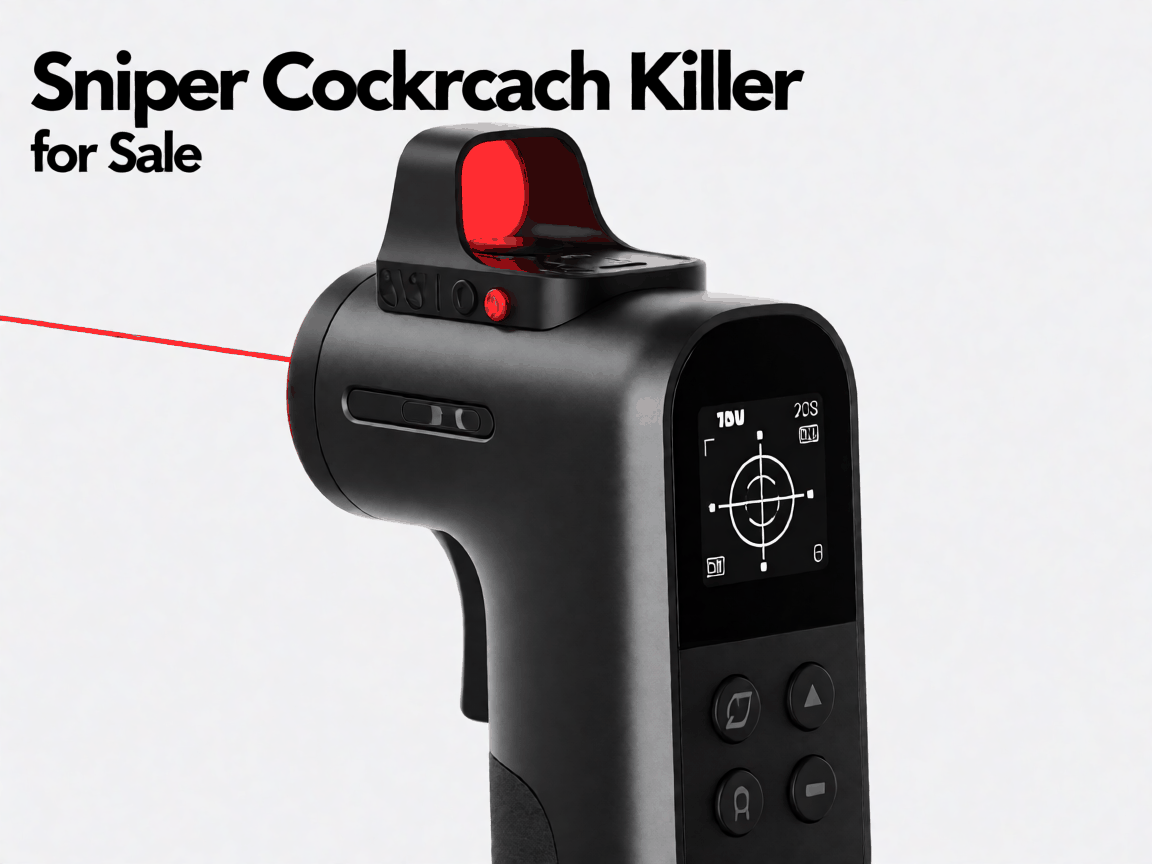
Specifying sniper cockroach killer for sale for Wholesale and OEM Orders
How It Performs in Use
Construction options diverge as soon as weight matters for the active payload — the carrier matrix determines whether the bait stays palatable for two weeks or two months in a commercial kitchen.
The working principle centres on a non-repellent active ingredient that foraging workers transfer through trophallaxis and necrophagy. Gel formulations use a proprietary carbohydrate-protein matrix that resists desiccation at 30 % RH while remaining soft enough for mandible penetration. Aerosol variants deliver a 15–25 µm droplet spectrum that coats harbourage surfaces without puddling; the solvent system flashes in under eight seconds so re-entry time stays under one hour. Both formats are registered for indoor food-handling areas when applied per label.
Specification Agreement Checkpoint
Before production, the buyer approves: active ingredient certificate of analysis (≥ 98.5 % purity), carrier rheology curve at 25 °C / 60 % RH, droplet size distribution report for aerosols, and artwork proof with mandatory signal words, PPE pictograms, and batch traceability code. Deviation triggers a new sample run — no exceptions.
Option Comparison by Usage Level
Cost and durability pull in opposite directions once the infestation pressure exceeds ten live catches per trap per night.
- Low pressure (residential, < 5 catches/trap/night) — 30 g syringe gel, 0.05 % fipronil. One placement per 3 m linear crack. Revisit at 90 days. Annotation: lowest cost per placement; requires dry harbourage.
- Medium pressure (restaurants, 5–15 catches) — 60 g cartridge gel, 0.05 % fipronil + 0.5 % attractant enhancer. Two placements per 3 m. Revisit at 45 days. Annotation: enhancer reduces bait aversion in grease-heavy zones.
- High pressure (food processing, > 15 catches) — 200 ml aerosol, 0.1 % imidacloprid + 0.05 % pyriproxyfen IGR. Crack-and-crevice plus void injection. Revisit at 21 days. Annotation: IGR breaks nymph cycle; aerosol penetrates equipment voids gel cannot reach.
Each tier uses the same active ingredient lot; only carrier volume and adjuvant package change. That keeps COA management simple for the buyer.
Requirements by Buyer Segment
Where chlorine, sweat or UV exposure is routine, the packaging and label durability requirements shift dramatically.
Pest Control Operators
- Child-resistant caps mandatory (ISO 8317)
- Syringe plunger force 8–12 N for one-hand use
- Batch-specific QR code on every unit
Property Management / Hospitality
- Odourless formulation — guest corridor compliant
- Tamper-evident seal with property logo option
- SDS and label in three languages minimum
Private-label buyers add artwork lock date 30 days before fill; any change after that incurs plate charge and two-week delay.
Stock Availability and Reorder Planning
Active ingredient lots are allocated quarterly. Gel syringes hold 18 months shelf life at 25 °C; aerosols hold 24 months. Safety stock covers 60 days of forecasted draw at the agreed SKU velocity.
| SKU Variant | Standard Pack | Pallet Qty | Lead Time (FOB) | Reorder Trigger |
|---|---|---|---|---|
| 30 g Gel Syringe | 24 units / carton | 1,728 units | 14 days | 21 days cover |
| 60 g Gel Cartridge | 12 units / carton | 864 units | 14 days | 21 days cover |
| 200 ml Aerosol | 12 cans / carton | 648 cans | 21 days | 30 days cover |
Blanket orders with quarterly releases lock price and allocation; spot orders ride on available capacity only.
Export Packaging and Handling Protection
Aerosols ship as UN 1950 Class 2.2; gels ship as non-hazardous but require temperature-controlled containers (15–30 °C) above 35 °C ambient routes. Both use double-wall corrugated (ECT 48) with anti-slip tier sheets.
- Inner carton: heat-shrink wrap with desiccant sachet (gel only)
- Outer carton: hazard diamond, UN number, proper shipping name, gross weight, batch range
- Pallet: stretch wrap 70 gauge, corner boards, DO NOT DOUBLE STACK marking
- Container: data logger included for cold-chain verification on gel shipments > 14 days transit
Customs documentation package — commercial invoice, packing list, certificate of analysis, certificate of free sale, and SDS — ships electronically 48 hours before vessel departure.
Care, Storage and Service Life
Gel syringes stored nozzle-down at 5–25 °C retain 95 % active after 18 months. Aerosols stored upright at ≤ 50 °C retain propellant pressure within ± 5 % of spec for 24 months.
Field Failure Modes to Audit
- Bait hardening — replace if penetration force exceeds 0.8 N
- Nozzle clog — clear with 0.5 mm pin; do not enlarge orifice
- Propellant loss — weigh can; reject if > 3 % under filled weight
- Label delamination — re-label from master artwork if legibility fails
Technical support responds within four business hours for field complaints; root-cause report issued within five business days if batch-related.
Specification Review
Finalise the active ingredient grade, carrier rheology, droplet spectrum, artwork languages, and pack-out configuration before the sample run. A single approval cycle saves three weeks and the plate-change fee.
Request Specification Review


