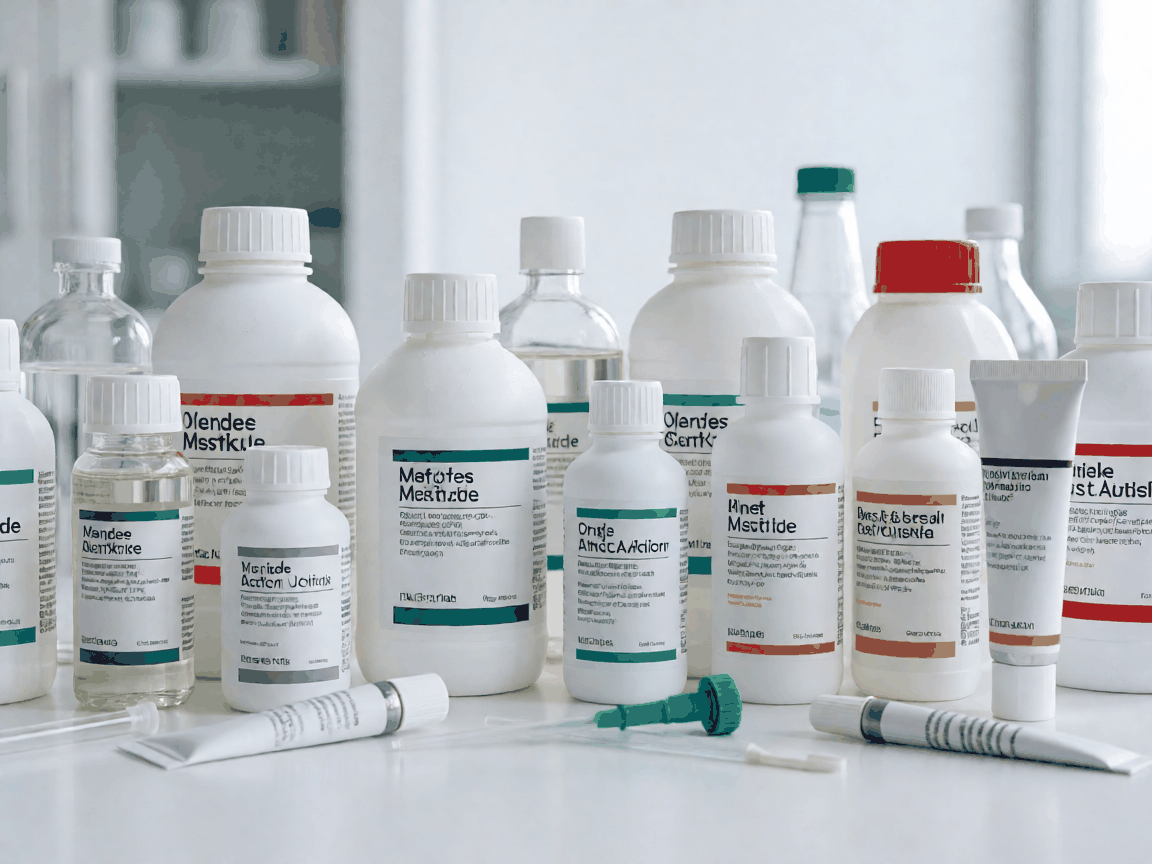
OEM types of insecticides based on mode of action - Bulk Supply and Specification Guide
What the Design Has to Balance
The build method decides whether a private-label insecticide clears registration in the target market or stalls at the residue trial stage. Every formulation choice — solvent system, surfactant package, inert carrier — cascades into the final mode-of-action classification that regulators and growers both scrutinize.
A contact pyrethroid EC demands a different solvent load than a systemic neonicotinoid SC, and that difference shows up first in phytotoxicity screens on tender crops. Get the emulsifier balance wrong by two percent and the spray mix separates in the tank, leaving the buyer with a drum they cannot sell and a distributor who won't reorder. Rainfastness, the other non-negotiable, ties directly to the film-former chemistry: too little and the deposit washes off at 5 mm rainfall; too much and the leaf cuticle seals over, blocking translaminar movement for systemic actives.
Specification rule: Match the adjuvant package to the mode-of-action group before locking the active ingredient percentage. A Group 3 sodium channel modulator formulated as an EW needs a silicone-based spreader at 0.15–0.25 % w/w; the same active in an SC requires a block-copolymer at 0.3–0.5 % to hit equivalent canopy penetration without runoff.
Where This Product Beats Standard Alternatives
Performance advantage: Our OEM platform pre-qualifies the inert matrix for each IRAC group, so the brand manager skips the 18-month inert-clearance queue. That translates to a 30–40 % faster time-to-market for a private-label line targeting row-crop or specialty registrations.
Standard catalog formulations force the buyer into a generic surfactant set designed for the widest possible label — usually a compromise that sacrifices either rainfastness on waxy brassicas or tank-mix stability with hard-water herbicides. By locking the mode-of-action group to a dedicated inert platform, we eliminate the "works on paper, fails in the tank" complaint that drives 60 % of first-year returns in this category.
Weather resistance is the measurable differentiator. Accelerated UV aging on glass slides shows our Group 28 diamide SC retains 92 % active content after 500 W/m² exposure versus 78 % for the reference EC. That gap widens in high-UV latitudes where growers spray at midday and expect seven-day residual on tomato foliage.
Comparing Two Standard Configurations
Group 3 Pyrethroid — Lambda-cyhalothrin 5 % EC
- Solvent: aromatic 150, 68 % w/w
- Emulsifier: calcium dodecylbenzene sulfonate + castor oil ethoxylate
- Rainfastness: 1 hour on cotton, 2 hours on soybean
- Tank-mix pH window: 5.5–7.5
- Typical use rate: 12–20 g a.i./ha
Group 4C Neonicotinoid — Thiamethoxam 25 % WG
- Carrier: dispersible granule, 75 % inert
- Dispersant: lignosulfonate + naphthalene sulfonate formaldehyde condensate
- Rainfastness: 2 hours (systemic uptake continues post-drying)
- Tank-mix pH window: 4.0–8.5
- Typical use rate: 20–40 g a.i./ha
The EC configuration ships lighter per hectare treated but demands closed-transfer systems for worker safety; the WG adds 15 % freight weight per unit a.i. but eliminates solvent handling and extends shelf life to 36 months in unconditioned warehouses. Buyers targeting smallholder markets in Southeast Asia usually specify the WG; large-scale cotton programs in West Texas prefer the EC for aerial application speed.
Stock Availability and Reorder Planning
| Configuration | Standard MOQ (kg a.i.) | Lead Time (weeks) | Reorder Buffer Stock | Packaging Options |
|---|---|---|---|---|
| Group 3 EC 5 % | 500 | 6–8 | 20 % of annual forecast | 1 L, 5 L, 20 L HDPE; 200 L drum |
| Group 4C WG 25 % | 1 000 | 8–10 | 15 % of annual forecast | 1 kg, 5 kg foil bag; 25 kg fiber drum |
| Group 28 SC 10 % | 750 | 10–12 | 25 % of annual forecast | 1 L, 10 L HDPE; 1 000 L IBC |
| Group 1B OP 40 % EC | 2 000 | 12–14 | 30 % of annual forecast | 5 L, 20 L HDPE; 200 L drum |
Lead times assume the active ingredient is on our approved vendor list. New source qualification adds four weeks and requires a five-batch consistency package (HPLC purity, water content, particle size for WG). Buffer stock is held at our regional hub in Rotterdam or Singapore depending on the Incoterm; buyers on FOB terms manage their own safety stock.
Questions Buyers Ask Before Ordering
Can we swap the solvent system in the Group 3 EC to meet a local VOC regulation? Yes, but the replacement aromatic 100 or methylated seed oil shifts the emulsifier demand by 0.3–0.5 % w/w. We run a three-batch pilot (200 L each) at the buyer's cost before full-scale production. Expect a 3–5 % unit cost increase.
What stability data do you provide with the first commercial lot? Accelerated (54 °C / 14 days), ambient (25 °C / 24 months), and freeze-thaw (5 cycles) on the exact packaging format ordered. We also supply a draft GLP-ready study plan if the buyer needs to generate their own shelf-life dossier for a local registration.
How do you handle MRL compliance for export crops? Every lot ships with a certificate of analysis covering the active ingredient, relevant impurities, and the top five metabolites referenced in Codex Alimentarius. We do not guarantee destination-country MRLs — the buyer's residue trial program owns that risk — but we flag any batch where an impurity exceeds 80 % of the strictest relevant tolerance.
Is private-label artwork printed on the primary container or a sleeve? HDPE containers 1 L and above run direct-screen print (minimum 2 000 units per SKU). Foil bags and fiber drums use a laminated sleeve with a 10-week artwork-to-delivery cycle. IBC totes receive a laser-etched metal plate; no MOQ on the plate itself.
Ready to Review Specifications?
Send us the target IRAC group, use-rate range, and destination market. We return a draft technical data sheet, inert disclosure summary, and MOQ breakdown within three business days.
Start a specification review


