OEM snail slug bait for corn and wheat: What Buyers Should Check Before Ordering
What Actually Determines Performance
Field efficacy comes down to three variables that interact in the row: pellet integrity after rainfall, attractant volatility under canopy humidity, and active ingredient homogeneity across the spread pattern. A batch that passes lab mortality assays but crumbles at 12 mm of rain will leave gaps in wheat at GS31 when slugs move up the stem. Corn at V4-V6 stage needs pellets that hold shape through irrigation cycles but still release metaldehyde or ferric phosphate fast enough to intercept nocturnal feeding.
The working principle relies on ingestion, not contact. Pellets must survive the spinner disc at 28-32 km/h peripheral speed, land intact, and remain palatable for 7-10 days under alternating wet-dry cycles. If the binder system hydrates too fast, you get a crust that slugs reject. If it hydrates too slow, the active ingredient doesn't mobilize. That narrow window is where formulation expertise separates a reorder from a warranty claim.
Critical Parameter Ranges
- Particle size: 2.0-3.5 mm (90% within range)
- Moisture content: 10-14% at packaging
- Bulk density: 0.65-0.85 g/cm³
- Attrition (100 rpm, 5 min): <2% fines
- Active ingredient CV: <5% across batch
Field Persistence Targets
- Rainfastness: >70% mass retention after 25 mm
- Palatability window: 7-10 days at 15-20°C
- Mould resistance: no visible growth at 14 days / 90% RH
- Spread uniformity: CV <15% at 24 m bout width
- Dust fraction: <0.5% by weight
How It Is Built and What That Changes
Consistency is set at the extrusion die. The pre-conditioning steam profile, die temperature, and knife speed determine whether you get a dense, smooth-surfaced pellet that sheds water or a porous matrix that wicks moisture into the core. We run twin-screw extruders with segmented barrel zones — typically 85°C at the feed throat, climbing to 110-115°C at the die for metaldehyde formulations, 5-8°C lower for ferric phosphate to prevent thermal degradation. The binder package (wheat flour, corn gluten, or proprietary polysaccharide) hydrates in the preconditioner; residence time there controls gelatinization degree and thus pellet hardness.
Post-extrusion, the pellets enter a fluid-bed dryer with controlled dew-point air. This step is where batch-to-batch drift hides. Over-dry pellets fracture on the spinner; under-dry pellets clump in the bag and develop surface mould within weeks. We target a narrow exit moisture band using inline NIR feedback, not timer-based discharge. The coating drum applies the attractant blend (yeast extract, cereal volatiles, metaldehyde synergist) as a micro-emulsion — this layer must survive abrasion in the spreader hopper but release within 30 minutes of soil contact.
Formulation Trade-off: Metaldehyde vs Ferric Phosphate
Metaldehyde (3-4% w/w) gives faster knockdown — dead slugs visible at 24 h — but degrades above 35°C soil temp and has stricter buffer zone requirements near waterways. Ferric phosphate (3-5% w/w) works slower (48-72 h), tolerates higher temperatures, and carries a more favourable ecological profile, but demands tighter pellet hardness control because the active is less mobile in the pellet matrix. Choose based on your grower's application window and regulatory environment.
Buying Mistakes That Lead to Returns
The most expensive mistake is specifying only active ingredient percentage and ignoring the physical specification. A buyer orders "4% metaldehyde pellets" and receives product that passes chemical assay but generates 4% fines in the spreader. Those fines bridge the hopper outlet, starve the disc, and leave 3-4 m untreated strips every bout. The grower blames the brand; the brand blames the OEM; the OEM points to the missing attrition spec in the purchase order.
Second mistake: accepting a single moisture certificate at load-out. Pellets equilibrate to ambient RH during transit. A shipment loaded at 12% moisture into a container at 65% RH arrives at 16% — soft enough to crush under bag stack weight, creating fines and hot spots for Aspergillus. Specify moisture at packaging, maximum equilibrium RH for transit, and require desiccant sachets or liner bags for sea freight over 21 days.
Third: skipping the spreader calibration trial. Bout width varies 15-20% between spinner models at the same RPM. A formulation optimized for a 24 m spreader at 540 PTO rpm will under-dose at 18 m or over-dose at 30 m. Insist on a spread pattern test report from the intended equipment class before locking the particle size distribution.
Requirements by Buyer Segment
Importers supplying national distributors need full registration dossier alignment — active source certification, five-batch stability data at 30°C/75% RH and 40°C/75% RH, and label artwork pre-approved by the local pesticide authority. They order 20-40 MT per SKU, require palletized 25 kg bags with UN-certified liners, and audit the manufacturing site annually. Their complaint threshold is zero tolerance for off-spec active content or missing batch traceability.
Wholesale buyers serving regional co-ops prioritize shelf-life consistency across seasons. They warehouse 6-12 months and need pellets that survive summer humidity without clumping or mould. They accept simpler packaging (10 kg woven PP, no liner) but demand a certificate of analysis per pallet tag, not per lot. Their reorder trigger is field performance reports from agronomists — if growers report patchy control, the SKU gets delisted.
Large farm purchasing managers (5,000+ ha) buy direct to control formulation specifics. They request custom attractant profiles for local slug species, specific pellet diameters matched to their pneumatic spreaders, and just-in-time delivery aligned with crop stage. They tolerate higher unit cost for guaranteed spread uniformity and will run their own jar bioassays on delivery. Their leverage is multi-year framework agreements with volume commitments.
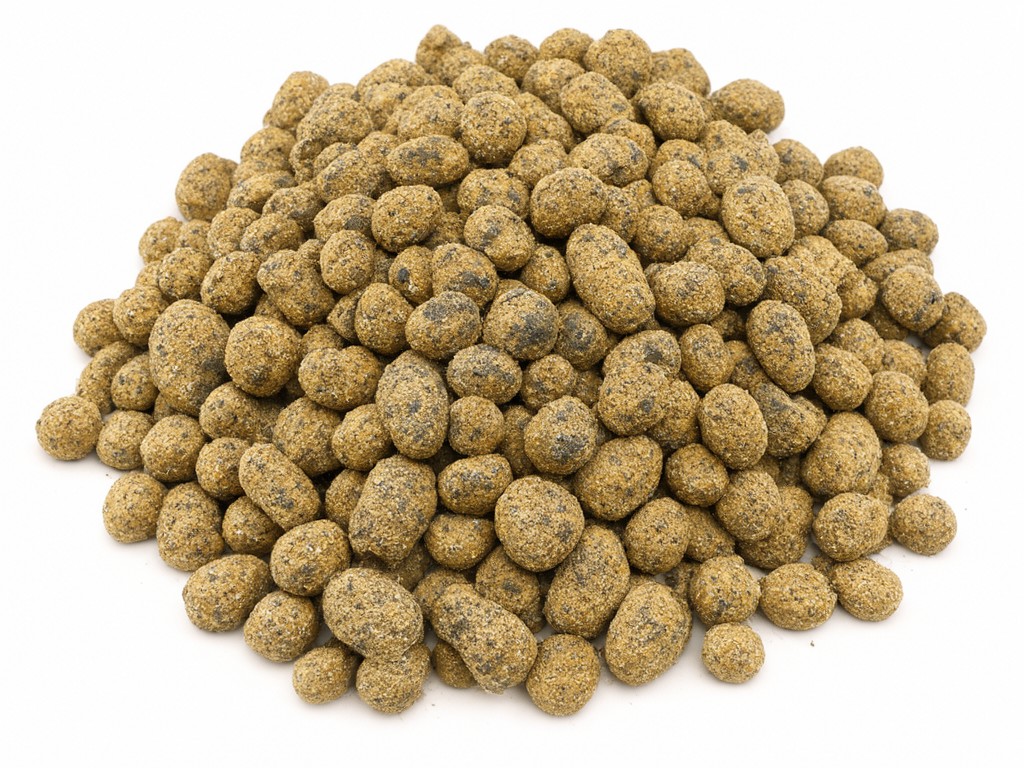
How Consistency Is Held Across Batches
First-article tooling determines the baseline. We lock die geometry, knife configuration, and preconditioner steam pressure after a 500 kg validation run that passes all physical and chemical specs. That tooling set is then dedicated to the SKU — no changeover to other diameters or formulations without a new validation. The extrusion line runs a statistical process control chart on pellet diameter (measured by laser diffraction every 15 min), moisture (inline NIR), and bulk density (grab sample per tonne). Any point outside 2σ triggers automatic die inspection.
Active ingredient homogeneity is verified by stratified sampling: 10 sub-samples per tonne, composited, then analysed by HPLC in duplicate. Acceptance criterion is 95-105% of label claim with RSD <3%. The attractant coating weight is checked by UV tracer fluorescence on 200 pellets per batch. Stability pulls happen at 0, 3, 6, 9, 12 months — same test panel as registration: moisture, attrition, mould count, active assay, and choice-box bioassay against Deroceras reticulatum. Data trends, not single points, drive specification adjustments.
| Packaging Configuration | Net Weight | Pallet Pattern | Liner / Barrier | Typical Use Case |
|---|---|---|---|---|
| UN 13H3 certified woven PP | 25 kg | 40 bags (8×5), stretch-hooded | PE liner + desiccant sachet | Export / regulatory markets |
| Standard woven PP | 10 kg | 100 bags (10×10), corner-boarded | None (inner dust coat only) | Domestic wholesale / co-op |
| FIBC with discharge spout | 500 / 1000 kg | 1 or 2 per pallet | Aluminized PE liner, N2 flush | Large farm direct / pneumatic spreader fill |
| Retail blister pack | 1 / 2.5 kg | Master carton 12×, display-ready | Foil laminate, child-resistant | Garden centre / smallholder (separate SKU) |
Request a Validation Sample
We ship 5 kg trial lots from the next scheduled production run — same die, same dryer profile, same coating drum. You test in your spreader, your climate, your slug pressure. Includes full COA, spread pattern protocol, and stability projection.



