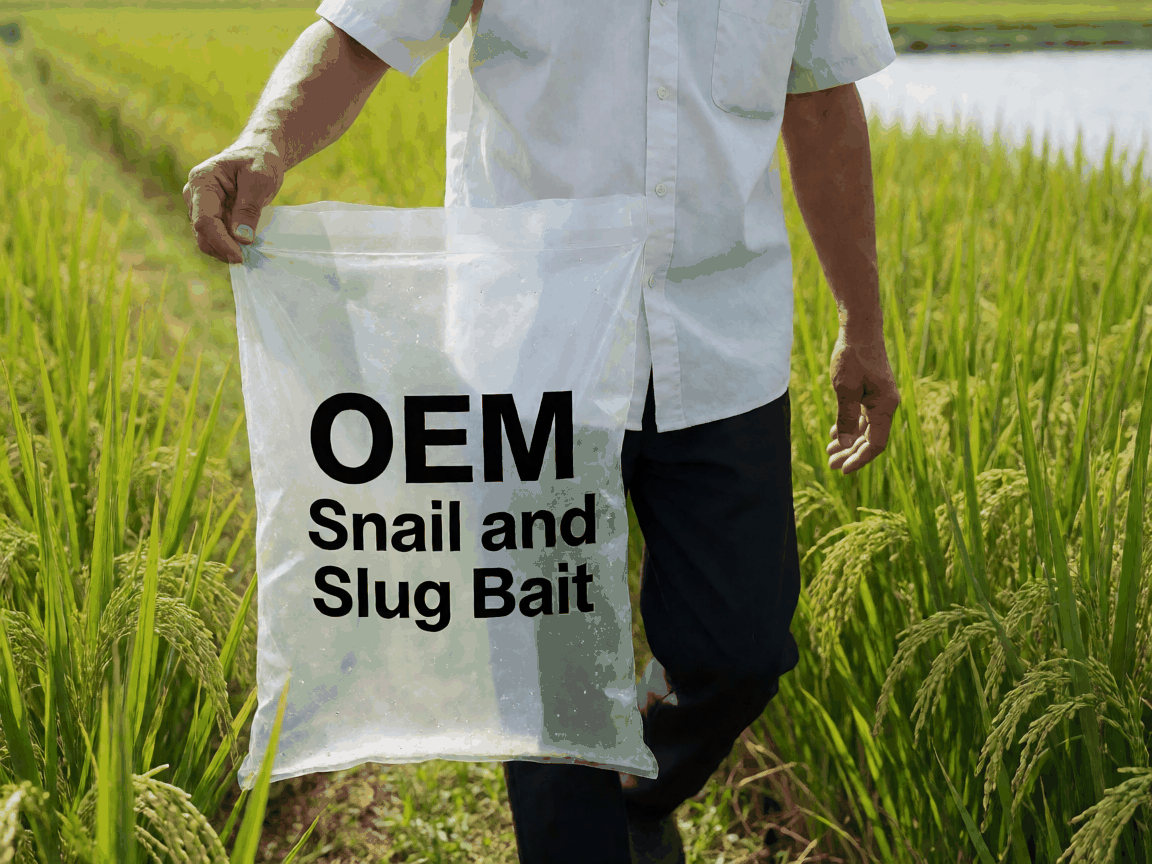
Specifying OEM snail and slug bait for rice fields for Wholesale and OEM Orders
Unit price settles the question only after you have accounted for the cost of returns. In the rice paddy context, the primary failure mode reported by importers is not efficacy, but physical degradation: granules crumbling before contact with the pest, active ingredient leaching during standing water exposure, or packaging tearing due to high humidity in transit. When a buyer reorders a batch that arrived 15% lighter than the spec due to hygroscopic absorption, the margin erosion is immediate. The specification must therefore address the material matrix first, not the active ingredient concentration alone.
For OEM snail and slug bait for rice fields, the buyer is typically a regional distributor or a private-label brand managing agricultural supply chains in Southeast Asia, South America, or Africa. The product faces a harsh service environment: constant saturation, UV exposure during application windows, and manual handling by laborers who may crush granules inadvertently. The specification below assumes a standard iron phosphate or metaldehyde matrix, encapsulated for slow release, intended for broadcast application in flooded fields.
Construction Method and Its Effect on Consistency
Before comparing quotations, understand that "granular" is a broad term that masks two distinct manufacturing processes with different lot-to-lot variances. The standard process for rice field applications is hot-melt extrusion combined with a coating step. The core consists of the active ingredient mixed with a starch or cellulose-based carrier. This core is then coated with a wax or polymer shell to control dissolution rates in standing water.
Critical Specification: Coating Integrity vs. Dissolution Rate
If the coating is too thick (typically >0.15mm), the granule becomes brittle and cracks during paddy broadcast, releasing the active ingredient instantly and wasting dose. If too thin (<0.05mm), the granule dissolves in the first 48 hours of standing water, rendering it ineffective against slugs that feed at night. The target coating weight is usually 5-8% of the total granule mass. Specify the coating material (e.g., paraffin wax vs. water-soluble polymer) explicitly, as this determines the shelf life in humid storage.
The second process variant is dry-mix pelleting. This is cheaper and faster but results in higher friability. In rice fields, where granules are often dropped from boats or by hand onto wet mud, dry pellets tend to disintegrate upon impact. The extrusion method produces a harder core that survives the drop from 1-2 meters without significant mass loss. For a wholesale order, the difference is measurable: extruded granules typically retain 95-98% of their initial weight after a simulated drop test, whereas dry pellets may retain only 85-90%.
Comparing Two Standard Configurations
Unit price and service life diverge sharply between the standard commodity configuration and the enhanced durability configuration. The decision is not about potency, but about how the granule behaves in the first 72 hours after application in saturated soil. The following selection logic helps align the product specification with the specific agronomic conditions of your target market.
- Configuration A: Standard Hot-Melt Extrusion (Paraffin Coating)
- Use Case: General broadcast in flooded rice paddies with moderate water turnover.
- Consistency: Granule size 1.0-1.5 mm. Coefficient of variation (CV) on weight typically 3-5%.
- Weather Resistance: Paraffin coating resists water but degrades under high UV. Shelf life in humid storage is approximately 12 months.
- Cost Driver: Lower energy consumption. Suitable for high-volume, price-sensitive markets.
- Configuration B: Enhanced Durability (Polymer Coating + UV Stabilizer)
- Use Case: Long-term standing water or fields with high evaporation rates. Suitable for export to tropical regions with high humidity.
- Consistency: Granule size 1.2-1.8 mm. CV on weight typically 2-3%. More uniform flow rate.
- Weather Resistance: Polymer coating is more resistant to cracking. UV stabilizer prevents coating degradation. Shelf life extended to 18-24 months.
- Cost Driver: Higher raw material cost for polymer and stabilizer. Premium pricing justified by reduced waste and longer inventory holding time.
The trade-off is clear: Configuration A minimizes unit cost but requires faster inventory turnover to avoid degradation. Configuration B increases the per-unit price by 15-20% but reduces the risk of returns due to product failure in transit or storage. For an importer managing a multi-month supply chain, the extended shelf life of Configuration B often offsets the higher upfront cost by reducing spoilage and replacement orders.
What Gets Checked Before Shipment
Inspection protocols for OEM agricultural chemicals focus on physical consistency and chemical stability, not just label compliance. The factory must provide test data for the specific lot shipped. The following table outlines the critical parameters that define the "Finish_and_Colour_Options" specification, which directly impacts visual identification in the field and quality control during blending.
| Parameter | Standard Specification | Enhanced Specification | Impact on Buyer |
|---|---|---|---|
| Granule Colour | Green (with 5% white speckle) | Uniform Green (no speckle, UV-stable) | Uniformity aids in visual application coverage checks. Speckle can indicate incomplete coating. |
| Particle Size Distribution | 1.0 - 1.5 mm (90% within range) | 1.2 - 1.8 mm (95% within range) | Larger granules settle faster in standing water, reducing drift loss. Tighter distribution ensures consistent dosing. |
| Bulk Density | 0.6 - 0.7 g/cm³ | 0.7 - 0.8 g/cm³ | Higher density indicates less air voids, which correlates with better flowability from hand-broadcasting. |
| Moisture Content | ≤ 5.0% | ≤ 3.0% | Lower moisture prevents caking in humid storage conditions. Critical for long sea freight. |
Beyond physical dimensions, the factory must perform a "Water Immersion Test" on a sample of the lot. A representative sample (typically 100g) is submerged in water at 25°C for 24 hours. The weight loss should not exceed 10% for Configuration A and 5% for Configuration B. If the weight loss exceeds these thresholds, the coating is too porous, and the batch should be rejected or re-processed. This test is the primary defense against the "crumbling granule" complaint that leads to warranty claims.
Packing, Marking and Freight Configuration
Packaging for rice field bait is not just a container; it is a barrier against humidity. Standard retail units are 1kg or 5kg polypropylene bags. For OEM orders, the bag construction must include a moisture barrier layer. A typical specification is a 100-micron outer PP layer, a 50-micron aluminum foil barrier, and a 50-micron inner PE layer. This "triple-wall" construction is essential for markets with relative humidity above 70%.
The marking on the bag must include the lot number, date of manufacture, expiry date, and active ingredient content. The lot number is critical for traceability. If a buyer receives a complaint about efficacy, the lot number allows the factory to correlate the issue with specific raw material batches. The printing must be heat-resistant, as bags are often stacked in hot warehouses. Water-based inks may smear; UV-cured inks are preferred for durability.
Freight configuration affects the physical integrity of the product. Granular bait is dense. A 20ft container can hold approximately 20-22 tonnes of this product, depending on the bag size and packing density. The bags must be stacked in a way that prevents crushing of the bottom layers. Cardboard dividers or pallets are recommended for bulk orders. If the buyer specifies "floor-loaded" shipping, the factory must ensure the inner bags have sufficient compression resistance to withstand the weight of the layers above. A simple compression test (applying 5kg for 10 minutes) on the inner bag can predict whether the product will arrive intact.
Ordering, Tooling and Lead-Time Questions
What is the MOQ for custom coating colours?
The minimum order quantity for a non-standard colour (e.g., orange instead of green) is typically 5 tonnes. This is because the pigment must be added to the masterbatch, and the extruder must be cleaned thoroughly to prevent cross-contamination. Cleaning time and material loss make small runs of custom colours economically unviable for most factories. If your volume is below 5 tonnes, stick to standard green or white options to avoid surcharges.
How does lead time vary between standard and enhanced configurations?
Configuration A (Standard) has a lead time of 15-20 days from order confirmation, as it uses pre-existing raw material stock. Configuration B (Enhanced) takes 25-35 days because the polymer coating and UV stabilizers often need to be imported or specially blended. If your marketing campaign is time-sensitive, specify Configuration A and plan for faster inventory turnover. If you are building a long-term inventory, Configuration B is safer despite the longer wait.
Can I provide my own artwork for the bag packaging?
Yes, but you must provide artwork in vector format (AI or PDF) with CMYK color mode. The factory will create a digital proof for approval before printing. Be aware that color matching is approximate; the factory can match a Pantone code but cannot guarantee 100% consistency across different printing runs. Allow a 5% tolerance in color variation. If brand consistency is critical, request a physical sample bag for approval before mass production.
Artwork and Branding Review
To ensure your label complies with local agricultural regulations and matches your brand standards, send your design files to our team for a pre-production review. We will check for regulatory text requirements (warning labels, usage instructions) and provide feedback on print feasibility.
Contact our technical team for an artwork review and sample request


