Oem Farm Dedicated Thiamethoxam Pest Control Supplier - Bulk Supply and Specification Guide
What the Design Has to Balance
Formulation stability dictates every downstream decision.
A farm‑dedicated thiamethoxam product must deliver consistent active ingredient (AI) content across 20‑tonne batches while surviving monsoon humidity, 40 °C container temperatures, and mechanical vibration during inland transport. The surfactant package has to keep particles below 5 µm D90 after 14 days at 54 °C accelerated aging, yet remain compatible with the grower’s tank‑mix partners — phosphate fertilizers, copper fungicides, and adjuvant oils. If the dispersion fails, nozzles clog; if the pH drifts above 8, hydrolysis accelerates and efficacy drops 15‑20 % within a week. Therefore the specification window for water solubility, suspensibility, and wet sieve residue is narrow, and every raw material lot is pre‑qualified by HPLC and CIPAC MT 184 before release.
How It Performs in Use
Field performance hinges on systemic translocation speed and rainfastness.
After foliar application, thiamethoxam moves acropetally through xylem, reaching new leaf tissue within 24 hours at 25 °C. Root uptake from soil drench is slower — peak leaf concentrations at 48‑72 hours — but provides longer residual control against sucking pests such as aphids and whiteflies. Rainfastness is achieved once the spray film dries, typically 2‑4 hours under canopy; however, heavy rainfall (>25 mm) within the first hour can wash off 30‑40 % of deposited AI. The formulation’s film‑forming polymer reduces this loss to under 10 % when applied at the label rate of 100 g AI/ha.
Critical Compatibility Note
Do not tank‑mix with strongly alkaline materials (pH > 8.5) or organophosphate insecticides. Pre‑test a jar mix at field concentration; if flocculation or layering occurs within 15 minutes, adjust pH to 6.5‑7.0 with a buffered acidifier before adding the thiamethoxam dispersion.
Material Options and Their Trade-offs
Technical grade purity drives cost and regulatory risk.
Three AI grades are commercially available: 98 % min (standard), 99 % min (low‑impurity), and 99.5 % min (export‑grade). The standard grade contains up to 0.8 % clothianidin isomer, which some importing countries flag as an impurity requiring separate MRL declaration. Low‑impurity grade reduces that isomer to <0.2 %, simplifying dossier submission for EU and Japan markets but adds $1.2‑1.5/kg. Export‑grade further limits heavy metals (Pb < 5 ppm, As < 2 ppm) and passes FAO/WHO 2022 spec for water‑soluble granules. Formulant choice follows a similar logic: naphthalene sulfonate dispersants give the best suspensibility (<0.5 % sediment after 30 min) but can foam in high‑shear mixing; polyacrylate dispersants foam less but require 0.3 % higher dosage to hit the same D90. Carrier selection — kaolin vs. silica — affects dustiness during bag filling; silica reduces respirable dust by 40 % but increases bulk density, raising freight cost per hectare treated.
Specification Range and Customisation Limits
Buyers define the window; the factory locks the process.
| Parameter | Standard Range | Customisation Limit | Test Method |
|---|---|---|---|
| Active ingredient content | 25 % ± 0.5 % w/w (WG), 240 g/L ± 5 g/L (SC) | 20‑30 % WG; 200‑350 g/L SC | HPLC (CIPAC 333) |
| Particle size D90 | < 5 µm | 3‑8 µm (adjustable via bead mill) | Laser diffraction (ISO 13320) |
| Suspensibility | > 90 % after 30 min | > 85 % (high‑load SC) | CIPAC MT 184 |
| Wet sieve residue (75 µm) | < 0.5 % | < 1.0 % (granular) | CIPAC MT 185 |
| pH (1 % dilution) | 6.0‑7.5 | 5.5‑8.0 (buffered) | CIPAC MT 75.3 |
| Accelerated storage (54 °C, 14 d) | AI loss < 2 %; suspensibility > 85 % | AI loss < 3 % (tropical pack) | CIPAC MT 46.3 |
Customisation beyond these limits requires a new pilot run (minimum 500 kg) and a revised stability protocol, adding 4‑6 weeks to lead time.
Option Comparison by Usage Level
Choose the grade that matches your market’s regulatory and price ceiling.
Standard Grade (98 % AI)
- Lowest unit cost — fits price‑sensitive regional tenders.
- Clothianidin isomer 0.6‑0.8 % — may require separate MRL in strict jurisdictions.
- Suitable for domestic markets with established registration.
Export Grade (99.5 % AI)
- Meets FAO/WHO 2022 spec; heavy metals below 5 ppm Pb, 2 ppm As.
- Clothianidin < 0.1 % — simplifies EU/Japan dossier.
- Premium pricing justified by reduced regulatory friction and faster registration.
Keeping Repeat Orders Supplied
Forecast sharing cuts lead time in half.
We maintain a rolling safety stock of 15 % of annual contracted volume for each registered formulation. When a buyer provides a 12‑month forecast with quarterly firm commitments, the factory schedules continuous campaigns — 10‑tonne batches every 3 weeks — eliminating the 4‑week changeover penalty. Without a forecast, each order triggers a dedicated campaign: raw material procurement (2 weeks), QC clearance (1 week), production (1 week), and stability hold (2 weeks) before release. That stretches delivery to 6‑8 weeks versus 3‑4 weeks under a shared plan. Batch certificates of analysis (CoA) are issued electronically within 24 hours of release; each CoA includes HPLC chromatogram, particle size distribution, and accelerated storage snapshot. Traceability links lot number to raw material certificates, equipment log, and operator sign‑off, enabling rapid root‑cause analysis if a field complaint arises.
Export Packaging and Handling Protection
UN‑certified packaging is non‑negotiable for sea freight.
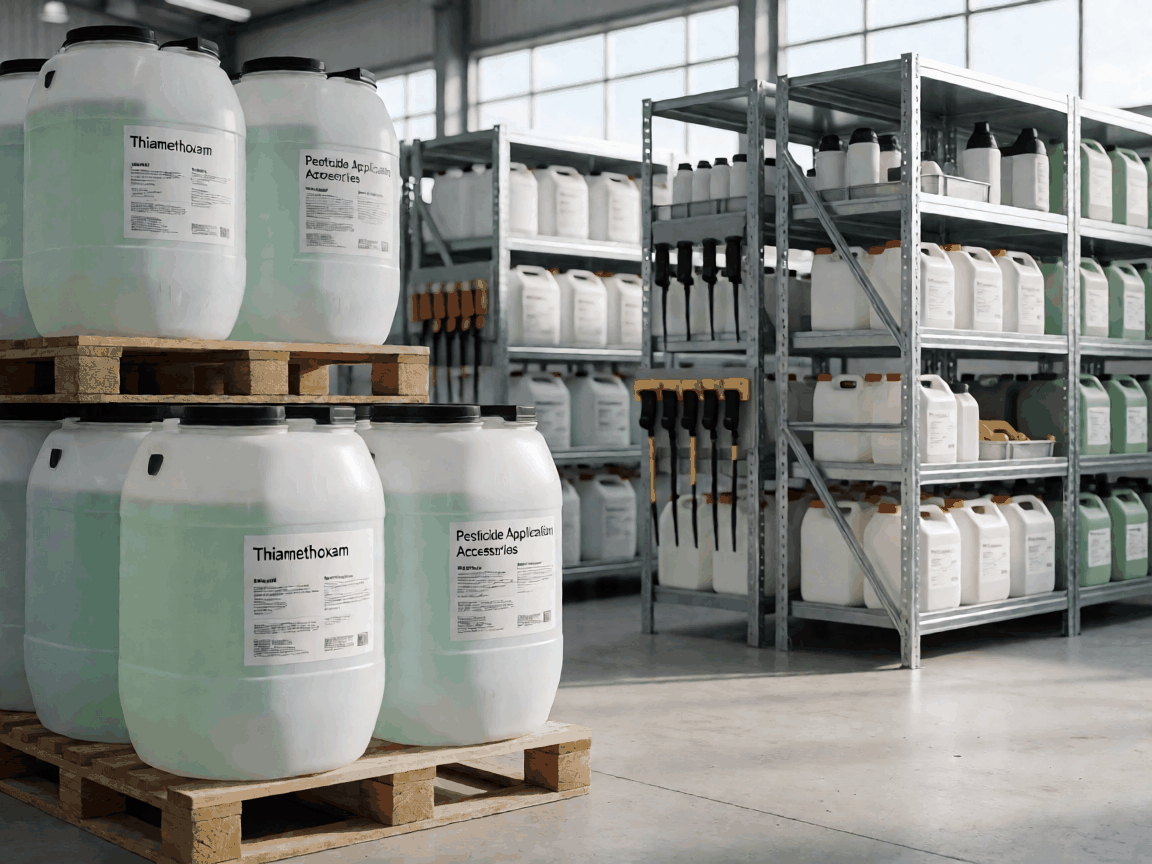
Water‑dispersible granules ship in 25 kg polyethylene‑lined kraft bags, 40 bags per pallet, stretch‑wrapped with UV‑stabilized film. Suspension concentrates use 200 L UN‑approved HDPE drums with fluorinated inner surface to prevent permeation; each drum receives a tamper‑evident seal and a GHS‑compliant label printed in the destination language. For bulk tanker loads (ISO‑tank, 20 t), the interior is passivated with food‑grade phosphoric acid rinse and nitrogen‑purged to < 5 ppm O₂. All pallets and drums undergo ISTA 3A drop and vibration testing before first shipment; subsequent lots are verified by dimensional check and seal integrity test. Temperature loggers are included in every container when the route crosses the equator — data downloaded at receipt to confirm no excursion above 45 °C.
| Packaging Option | Net Weight | UN Rating | Customisation Scope |
|---|---|---|---|
| PE‑lined kraft bag | 25 kg | 4G/Y30/S | Print: up to 4 colours; logo + batch QR code |
| HDPE drum (fluorinated) | 200 L (≈ 240 kg) | 1A1/Y1.8/200 | Label: custom GHS, language, barcode |
| ISO tank (20 ft) | 20 t | T11/IMO 2 | Stencil: customer name, product code, hazard class |
Ready to Finalise Your Specification?
Submit your draft label, target AI content, and forecast volume. We return a technical data sheet, regulatory gap analysis, and a firm quotation within 3 business days.
Start Artwork and Branding Review


