Metaldehyde Technical Suppliers: Specification, Ordering and Quality Notes
What This Product Is and Where It Fits
Metaldehyde technical grade is the high-purity active ingredient shipped to formulators who convert it into molluscicide baits, typically 3–5 % pellets or mini-pellets for agricultural and horticultural use. Buyers are importers, regional distributors and large-scale formulators who need consistent assay, particle profile and thermal stability so that every downstream batch passes efficacy registration and field performance specs.
The material leaves the reactor as a cyclic tetramer of acetaldehyde, crystallised, dried and milled to a defined sieve cut. Purity drives both the toxicological clearance and the cost-in-use for the formulator: a 0.2 % assay drop can mean 4–5 kg more active per tonne of finished bait, which erodes margin fast on repeat contracts.
Where Cheaper Alternatives Fall Short
| Failure Mode | Typical Root Cause in Low-Grade Supply | Downstream Consequence |
|---|---|---|
| Assay drift batch-to-batch | Inadequate crystallisation control; mother-liquor carryover | Re-formulation delays, failed GLP efficacy trials |
| Wide particle size distribution | Single-pass milling without air classification | Segregation in pellet press, uneven field deposition |
| Excess moisture > 0.3 % | Insufficient drying or hygroscopic packaging | Caking in super-sacks, dust explosion risk elevation |
| Acidity spike (pH < 5) | Residual catalyst or incomplete wash | Accelerated decomposition in bait matrix, shelf-life failure |
Construction Method and Its Effect on Consistency
Process Control Points That Determine Repeatability
The limiting factor is rarely the headline specification but the narrow window around each unit operation. Reactor temperature profile during acetaldehyde oligomerisation sets the isomer ratio; a 2 °C excursion shifts the cyclic tetramer yield by 1.5–2 %, directly moving the assay ceiling. Crystallisation cooling curve (typically 60 → 10 °C over 4 h) governs crystal habit — needle-like crystals fracture into fines during milling, broadening the PSD and creating segregation risk in the pellet die.
Centrifugal washing must reduce free acetaldehyde to < 500 ppm; residual monomer not only depresses assay but catalyses autocatalytic decomposition during summer container transit. Final fluid-bed drying at 35–40 °C inlet air, 0.5 m/s superficial velocity, targets 0.15 % moisture with a ±0.05 % batch spread — tighter than the pharmacopeia monograph because formulators run continuous lines that choke on damp powder.
Quality Control and Batch Consistency
Fatigue appears at the stress concentration of analytical verification: every released lot carries a certificate of analysis with HPLC assay (external standard, C18 column, 60:40 water:MeOH), Karl Fischer moisture, laser diffraction PSD (D10/D50/D90), sieve residue on 250 µm and 63 µm, pH 10 % slurry, and heavy metals by ICP-MS (Pb, Cd, As, Hg < 10 ppm each). Retain samples are held 24 months at 25 °C/60 % RH and 40 °C/75 % RH; degradation kinetics must show < 0.5 % assay loss at 12 months to support the formulator's two-year bait shelf-life claim.
Batch release protocol requires three consecutive lots within ±0.3 % assay and ±5 µm D50 before a new campaign is qualified for standing-order supply. Any single-lot deviation triggers root-cause investigation and a hold on the next two production runs until statistical process control limits are re-established.
Stock Availability and Reorder Planning
Standard Lead-Time Model
- Ex-works availability: 15–20 business days after PO confirmation for 10–20 t lots
- Vessel allocation: 7–10 days at major Chinese ports (Qingdao, Shanghai) or EU hubs (Rotterdam, Antwerp)
- Transit: 28–35 days to US Gulf, 22–28 days to Brazil, 18–22 days to West Africa
Buffer Stock Strategy
- Minimum 60-day safety stock at formulator's warehouse covers single-vessel delay
- Dual-source qualification (two approved plants) cuts single-plant outage risk by 80 %
- Rolling 12-month forecast shared quarterly locks production slots and stabilises pricing
Packing, Marking and Freight Configuration
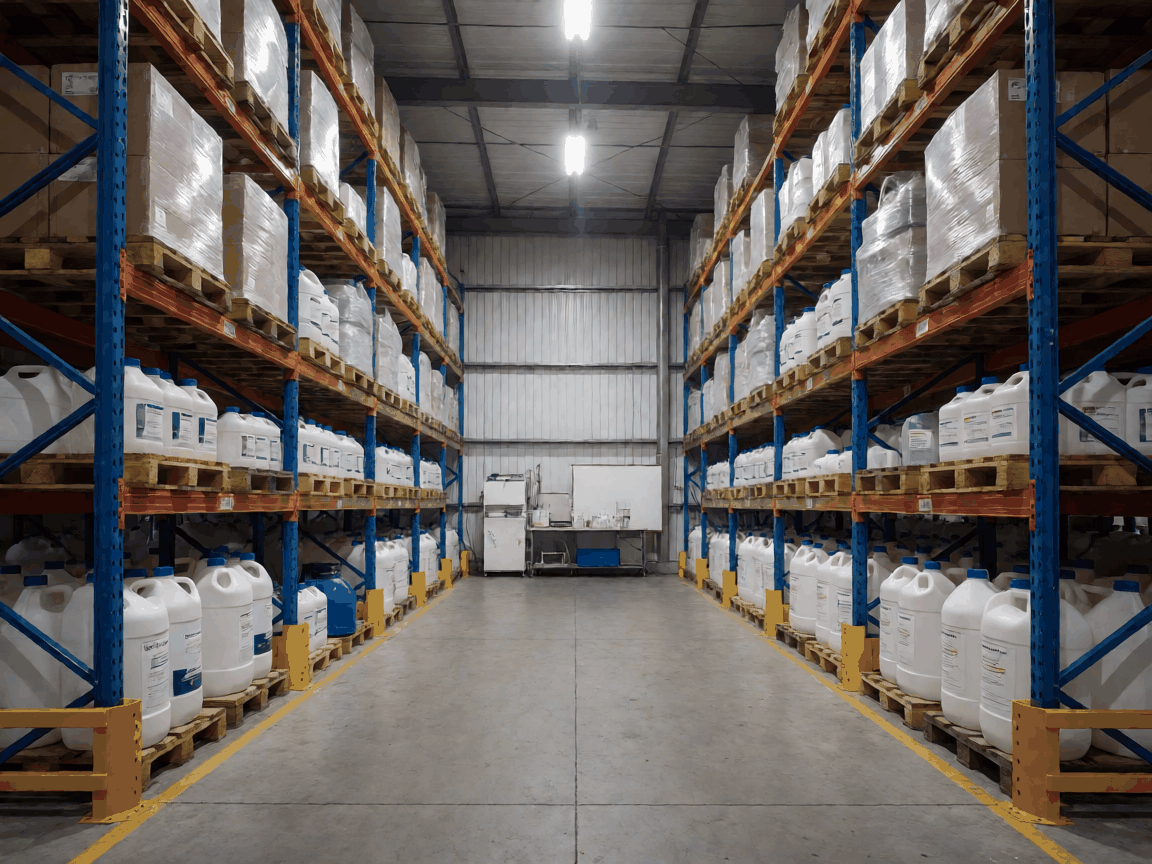
Standard pack is 25 kg net PE-laminated kraft bags, 40 bags per fumigated wooden pallet (1 000 kg nett), stretch-wrapped and corner-boarded. Super-sack option (500 kg or 1 000 kg FIBC with PE liner, UN certified 13H3/Y) reduces handling cost but demands forklift access at discharge — confirm receiving capability before specifying. Every pallet carries two weatherproof labels: GHS pictograms (Flammable Solid 4.1, Acute Toxicity), UN 1332, proper shipping name "Metaldehyde", net/gross weight, lot number, manufacturing date, retest date, and supplier code for traceability.
Container loading: 20 ft GP takes 20 pallets (20 t) with 100 mm headspace for ventilation; 40 ft HC takes 44 pallets (44 t) but requires weight distribution plan to avoid axle overload. Desiccant sachets (2 kg silica gel per pallet) are mandatory for voyages > 25 days or transits through tropical zones — condensation cycles drive the caking complaints that trigger returns.
Next Steps: Artwork and Branding Review
Label compliance varies by destination market — EPA establishment number for US, MAPA registration for Brazil, PCP number for Canada, FAO specification alignment for West Africa. We supply draft artwork files (AI, PDF/X-1a) matched to your registered label layout, including barcode, QR traceability code and multilingual hazard phrases. Approval cycle is typically two revisions within five business days.
Ready to lock in specification, lead-time and labelling for your next campaign? Submit your forecast and destination ports and we'll return a firm offer with batch-release protocol attached.



