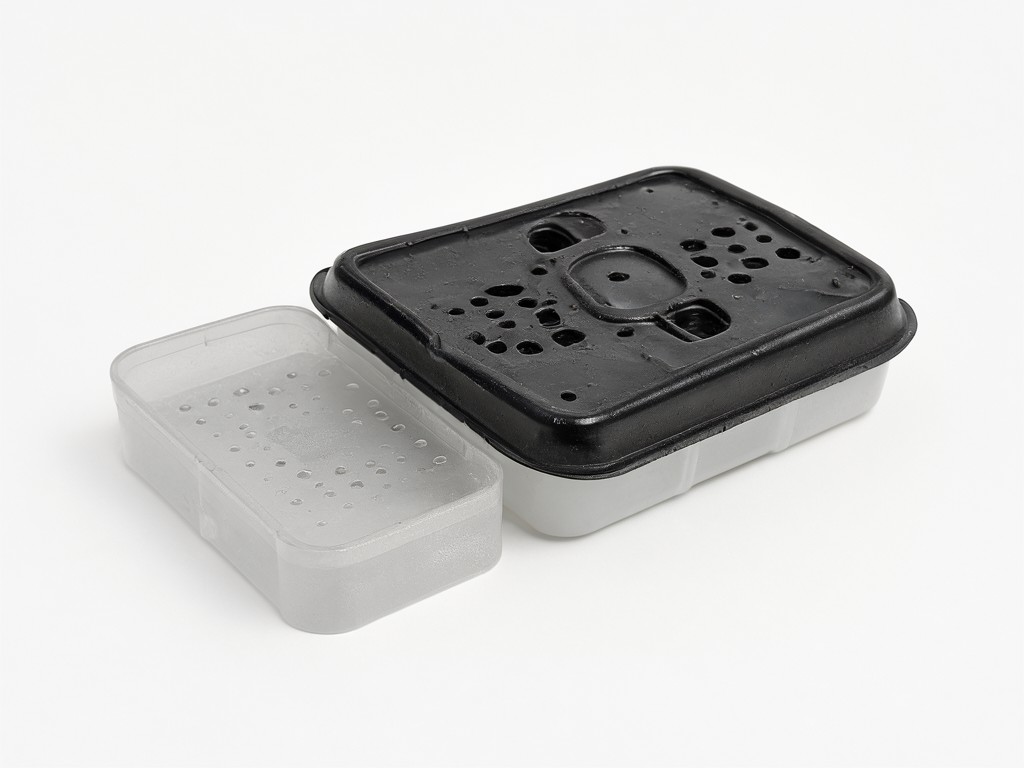
Specifying China waterproof moisture proof cockroach trap supplier for Wholesale and OEM Orders
The trap that holds adhesive strength at 85 % RH costs 12–18 % more per thousand than a standard board, but it cuts field replacements by roughly half in commercial kitchens and basements. Buyers who spec on unit price alone usually reorder within six weeks because the adhesive bleeds or the bait degrades in damp service conditions.
What the Design Has to Balance
Replacement rate, not unit price, drives the real cost structure. A trap that loses 30 % of its catch rate after two weeks in a steam-cleaned kitchen forces the end user to double the placement density, which doubles the labour cost per service visit. The moisture barrier layer — typically a 25 µm PE extrusion laminate on the trap face — adds roughly 0.04 USD per unit but keeps the adhesive tack within ±10 % of spec after 30 days at 90 % RH. Without it, the hot-melt adhesive softens, the bait matrix migrates, and the cardboard substrate delaminates at the score lines.
The trade-off sits in the adhesive formulation. A high-tack styrene-block copolymer holds German and American cockroaches reliably down to 5 °C, but it strings during high-speed die-cutting and raises tooling wear. A lower-tack EVA blend runs cleaner on the rotary press but drops 15–20 % catch efficiency on large nymphs. Most private-label programmes settle on a mid-range SBS formulation with 8 % tackifier loading, accepting a 3 % increase in web breaks to keep the catch curve flat across the target species range.
How Consistency Is Held Across Batches
Tooling amortisation decides the inspection regime. The rotary die that cuts the trap profile and the score lines for the tent fold runs at 120 m/min; a 0.05 mm drift in the score depth changes the fold angle by 3°, which alters the entry gap that nymphs exploit. Every 50,000 impressions the die is pulled for micrometer check on the score rule height and the cutting rule bevel. Adhesive coat weight is monitored inline with a beta gauge targeting 35 ± 3 g/m²; excursions beyond ±5 g/m² trigger an automatic web splice and a hold on the affected roll.
Bait consistency is the quieter variable. The attractant — usually a food-grade starch matrix with 2 % synthetic pheromone analogue — is metered by a volumetric piston filler. Viscosity drift of 10 cP changes deposit weight by 0.8 mg per trap, enough to shift the effective radius from 1.2 m to 0.9 m in still air. Each batch runs a gravimetric check on 30 traps per cavity; the lot is released only when the coefficient of variation across all cavities stays below 4 %.
| Parameter | Target Range | Test Method | Lot Acceptance |
|---|---|---|---|
| Adhesive coat weight | 35 ± 3 g/m² | Beta backscatter gauge | ±5 g/m² per roll |
| Score depth | 0.45 ± 0.03 mm | Micrometer on die rule | Every 50k impressions |
| Bait deposit weight | 12.0 ± 0.5 mg | Gravimetric, 30 traps/cavity | CV < 4 % across cavities |
| Moisture barrier WVTR | ≤ 1.5 g/m²/day | ASTM E96 water method | Per laminate lot |
| Trap dimensions (folded) | 100 × 70 × 22 mm ± 1 mm | Caliper, 10 traps/lot | All within tolerance |
| Adhesive shear (72 h, 40 °C / 90 % RH) | ≥ 180 min | ASTM D3654 modified | Per adhesive batch |
Capacity, Tooling and Scheduling
The rotary line produces 1.2 million traps per 12-hour shift at full speed. A private-label run requires a dedicated die set (cutting, scoring, perforation) plus a bait formulation changeover that takes 4 hours including flush and validation. Minimum economic run is 250,000 units — below that, the die amortisation and changeover waste push the per-unit cost above the standard catalogue price. Most distributors order in 500 k increments to keep the die cost below 0.0015 USD per trap.
Lead time from artwork approval to first pallet ex-works is 18 working days: 5 days for die manufacture, 3 days for laminate qualification, 2 days for adhesive batch qualification, 3 days for bait batch qualification, and 5 days for production and cure. The adhesive requires 72 hours at 23 °C / 50 % RH to reach final cross-link density; shipping before cure completion risks cold-flow in transit. Rush orders can compress to 12 days by running die manufacture in parallel with laminate qualification, but only if the artwork uses existing die geometry (standard 100 × 70 mm footprint).
Keeping Repeat Orders Supplied
Total cost of ownership shifts once returns are counted. A distributor carrying 20 SKUs of private-label traps typically sees 2–3 % return rate on moisture-compromised lots — crushed cartons, adhesive bleed, bait migration. Holding a 4-week buffer stock at the factory (roughly 200 k units per SKU) eliminates the expedited freight surcharge that adds 0.018 USD per trap when a stock-out hits mid-month. The buffer is rotated on a first-in-first-out basis; traps older than 9 months from manufacture are pulled for adhesive shear re-test before release.
Consignment stock at the distributor's DC works when the annual volume exceeds 1.5 million units per SKU. The factory retains title until pull, invoices monthly on consumption data, and replenishes on a 10-day kanban signal. This arrangement reduces the distributor's working capital by roughly 35 % but requires a shared forecast updated quarterly. Below that volume threshold, the administrative overhead of consignment outweighs the carrying-cost saving.
Export Packaging and Handling Protection
Traps are packed 72 per inner carton (6 × 12 layout), 10 inner cartons per master carton. The master uses double-wall B/C flute (ECT 48) with a moisture-barrier bag liner heat-sealed after vacuum evacuation to ≤ 5 kPa. This holds the internal RH below 45 % for 60 days at 30 °C ambient — enough for trans-Pacific transit plus 30 days DC dwell. Without the vacuum bag, the cardboard absorbs 8–10 % moisture by weight, the score lines relax, and the traps pop open in the master, jamming automated case erectors at the receiving DC.
Pallet configuration: 48 masters per pallet (8 layers × 6 per layer), stretch-wrapped with 23 µm blown film, 4 corner boards, and a top cap sheet. Gross weight 1,150 kg per pallet. Container load: 20 pallets in a 40' HC (960 masters, 691,200 traps). Temperature spikes above 45 °C in the container can soften the adhesive enough to cause blocking between traps in the inner carton; the vacuum bag mitigates this by keeping the traps physically separated, but shippers routing through Middle East hubs in July should specify a reefer set to 25 °C max.
Care, Storage and Service Life
Unopened master cartons hold spec for 18 months at 15–25 °C / 30–60 % RH. Once the moisture-barrier bag is opened, the inner cartons should be used within 60 days; beyond that, the adhesive coat weight drops 0.3 g/m² per week as moisture equilibrates, and the bait volatile profile shifts measurably after 90 days. Retail-ready display boxes (12 traps per box) are not hermetic — they are designed for 4-week shelf exposure in climate-controlled stores. In non-climate-controlled environments (garages, sheds), the display box life drops to 10–14 days before catch rate falls below 70 % of fresh-trap baseline.
End users should be instructed to place traps flush against wall-floor junctions, behind appliances, and under sink cabinets — locations where RH routinely exceeds 80 %. The tent-fold design creates a 6 mm entry gap that excludes debris but admits nymphs down to 3 mm body width. Traps should be replaced when 70 % of the adhesive surface is covered or at 30-day intervals, whichever comes first. In heavy-infestation accounts, a 14-day rotation is standard; the adhesive remains active but the bait depletion curve steepens after day 10.
Standard Configuration
Footprint: 100 × 70 mm folded
Adhesive: SBS hot-melt, 35 g/m²
Bait: Starch matrix + 2 % pheromone analogue
Moisture barrier: 25 µm PE extrusion laminate
Pack: 72/inner, 720/master
Upgrade Options
High-tack adhesive: +0.012 USD/unit, +15 % catch on large nymphs
Double bait load: +0.008 USD/unit, extends effective radius to 1.5 m
Retail display box: 12-trap litho-laminated, +0.025 USD/unit
Custom die footprint: One-time die cost 1,800 USD, 500 k MOQ
Reefer-qualified pack: Validated to 45 °C/90 % RH, +0.006 USD/unit
Ready to lock in the specification for your next production run? Send the target annual volume, preferred adhesive tack range, and any custom footprint or artwork requirements. We will return a formal quotation with die schedule, laminate qualification data, and a sample allocation plan within two business days.
Request specification review


