china indoor mouse repellent balls supplier: What Buyers Should Check Before Ordering
The main trade-off sits between active-ingredient load and binder integrity. A higher oil or crystalline concentration extends field life but softens the matrix, causing crumble in transit or premature disintegration in humid HVAC plenums. Specify the minimum acceptable friability index alongside the ingredient percentage, or the batch will pass QC and fail in the field.
What Actually Determines Performance
Process choice shows up later as release-rate drift. The build method decides whether the active ingredient migrates to the surface during curing or stays locked in the polymer matrix. Compression moulding at 80–120 °C with a thermoplastic binder gives a tight 0.8–1.2 g/day release window for peppermint-oil loads above 18 %. Extrusion-cut pellets, cheaper per kilogram, typically show 30 % wider variance because the shear heat drives volatiles off before the skin forms.
Consistency is set at the forming stage. If the die temperature profile isn't held within ±3 °C across the face, you get a bimodal hardness distribution — half the balls fracture at 12 N, the other half survive 25 N. That split shows up as customer complaints about "some balls dusting in the box" while others "last forever but don't smell." A proper supplier runs inline durometer checks every 50 kg and correlates the data with headspace GC samples pulled from the same lot.
Where This Product Beats Standard Alternatives
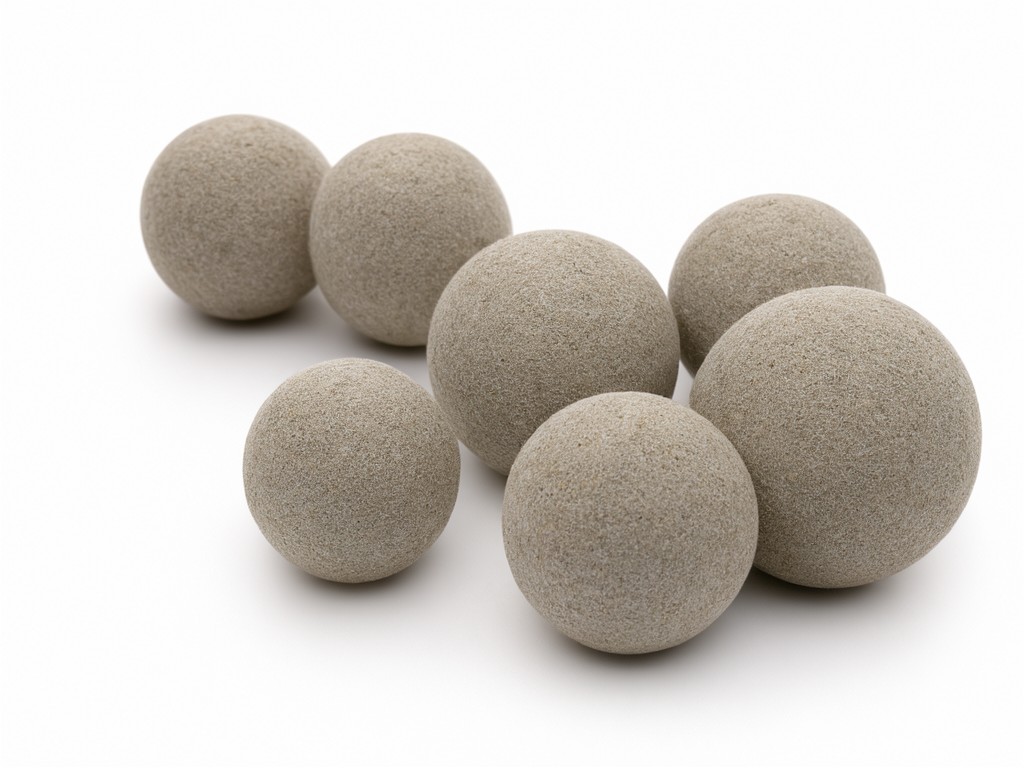
In suspended-ceiling plenums and raised-floor data halls, aerosol sprays settle on equipment and ultrasonic units lose line-of-sight. A 22 mm ball weighing 4.5 g with 20 % w/w d-limonene delivers a controlled vapour pressure of roughly 0.15 Pa at 25 °C — enough to maintain a repellent envelope in 15 m³ of still air for 45–60 days. The same active in a gel sachet drops below threshold in three weeks because the gel skin dries and cracks. Traps only catch after entry; these balls create a perimeter the rodents won't cross.
Food-processing zones need the NSF P1-rated variant — same matrix, but the binder is an FDA 21 CFR 177.2600 compliant SEBS grade. That swap adds $0.03/ball but removes the audit finding risk. General warehouse stock can run the standard styrene-ethylene-butylene binder at half the cost. The buyer who specifies one SKU for both environments either overpays or fails the audit.
Specification Range and Customisation Limits
Diameter runs 15–30 mm in 1 mm steps; weight scales with the cube, so a 15 mm ball is 1.1 g and a 30 mm ball is 8.8 g at 1.05 g/cm³ density. Active ingredient loading tops out at 30 % for peppermint oil, 25 % for naphthalene (sublimation risk above that), and 15 % for paradichlorobenzene (regulatory cap in EU/CA). Binder options: SEBS (standard), SEBS-food-grade, EVA (lower cost, higher dust), or PLA (compostable claim, but 40 % shorter field life in >60 % RH).
Colour masterbatch is free up to 2 % load; custom Pantone matching adds a $120 setup fee and 3-day delay. Private-label printing on the inner polybag (not the ball — ink solvents migrate) runs $0.015/unit at 50 k MOQ. Embossed lot codes on the ball surface are possible with a hardened-steel die insert ($850 tooling, 10-day lead) but only on diameters ≥20 mm; smaller balls don't have the flat area.
| Inspection Parameter | Method | Acceptance Criteria | Frequency |
|---|---|---|---|
| Active ingredient assay | Headspace GC-FID, 30 min at 40 °C | ±5 % of declared load | Every lot |
| Diameter & weight | Optical gauge + checkweigher | ±0.3 mm / ±3 % | Every 50 kg |
| Friability (tumble test) | 25 rpm, 100 revolutions, sieve 2 mm | <1.0 % mass loss | Every lot |
| Release rate (accelerated) | 40 °C / 75 % RH, gravimetric, 14 days | 0.8–1.2 g/day per 4.5 g ball | First 3 lots, then quarterly |
| Odour panel | 5 trained assessors, 1 m³ chamber | Detectable at 0.05 ppm, no off-notes | Every lot |
How to Choose Before Requesting a Quote
Start with the air-exchange rate of the target space. A server room at 12 ACH needs double the ball count per cubic metre compared to a static archive at 0.5 ACH. Then match the active to the regulatory ceiling: naphthalene is banned in California schools, paradichlorobenzene restricted in Canada, peppermint oil unrestricted but volatile. If the spec sheet doesn't list the test temperature for the claimed "60-day life," assume 25 °C still air — real plenums at 32 °C cut that to 35 days.
Ask for the friability data from the last three production runs. A supplier who only sends a COA for active ingredient is hiding the mechanical failure mode. Also request the accelerated ageing curve (40 °C/75 % RH) — if they don't run it, they don't know the shelf life. Minimum order quantity for a custom binder formulation is 2,000 kg; standard SEBS grades can start at 500 kg with a 15-day lead.
Buying Mistakes That Lead to Returns
Ordering the 15 mm "economy" size for a ceiling-tile dispenser designed for 22 mm — the balls rattle through the retention clips and end up on the floor. Specifying peppermint oil for a frozen-food warehouse at −18 °C; the oil viscosity spikes and release drops to near zero. Accepting a quote based on "≥18 % active" without a lower bound — the batch arrives at 18.2 % and the release rate fails the accelerated test. Skipping the transit simulation (ISTA 3A) on the master carton; the balls abrade each other, dust coats the inner bag, and the retailer rejects the pallet for "messy presentation."
The most expensive mistake is single-sourcing without a qualified second supplier. When the primary plant has a binder contamination event — last year a batch of SEBS arrived with 0.4 % residual styrene — the backup line must be pre-approved with identical die geometry and cure profile. Qualifying that backup takes 60 days and three trial lots. Do it before the crisis.
Volume Planning and Lead Time
Standard SEBS 22 mm / 20 % peppermint: 500 kg MOQ, 15 calendar days from artwork approval. Food-grade binder adds 5 days for the segregated mixer flush. Custom diameter tooling (new die) adds 10 days and $1,200. PLA compostable grade runs 1,000 kg MOQ, 22 days — the PLA pellets need pre-drying at 80 °C for 4 hours before extrusion, and the line changeover loses a shift.
Packaging configuration drives the real freight cost. Bulk 25 kg fibre drums (90 balls/kg) cube out at 0.35 m³/tonne — cheap sea freight but manual handling at the DC. Retail-ready 12-count blister packs in 100-count master cartons cube at 0.62 m³/tonne but arrive shelf-ready. A 40 HQ container takes 18 t bulk or 11 t retail-ready. Calculate your landed cost per deployed ball, not per kilogram ex-works.
Care, Storage and Service Life
Store sealed master cartons at ≤30 °C, ≤60 % RH. Above 35 °C the binder begins to plasticise; balls stick together in the bag and the surface oil bloom accelerates. Shelf life in original barrier packaging: 24 months for SEBS, 18 months for EVA, 12 months for PLA. Once the inner polybag is opened, use within 30 days — the active ingredient equilibrates with the headspace and the release rate shifts up 15–20 %.
Field replacement interval: plan on 45 days for 22 mm / 20 % peppermint in 25 °C / 50 % RH still air. In high-airflow plenums (>6 ACH) or >30 °C, cut to 30 days. Mark the installation date on the dispenser housing; don't rely on odour — olfactory fatigue makes staff think it's still working when the vapour pressure has dropped below the rodent detection threshold.
Ready to Review Specifications?
Send us your target space volume, air-exchange rate, regulatory constraints, and current unit cost. We'll return a marked-up specification sheet with the exact binder grade, diameter, and active load that meets your field-life requirement at the lowest landed cost.
Request a specification review →


