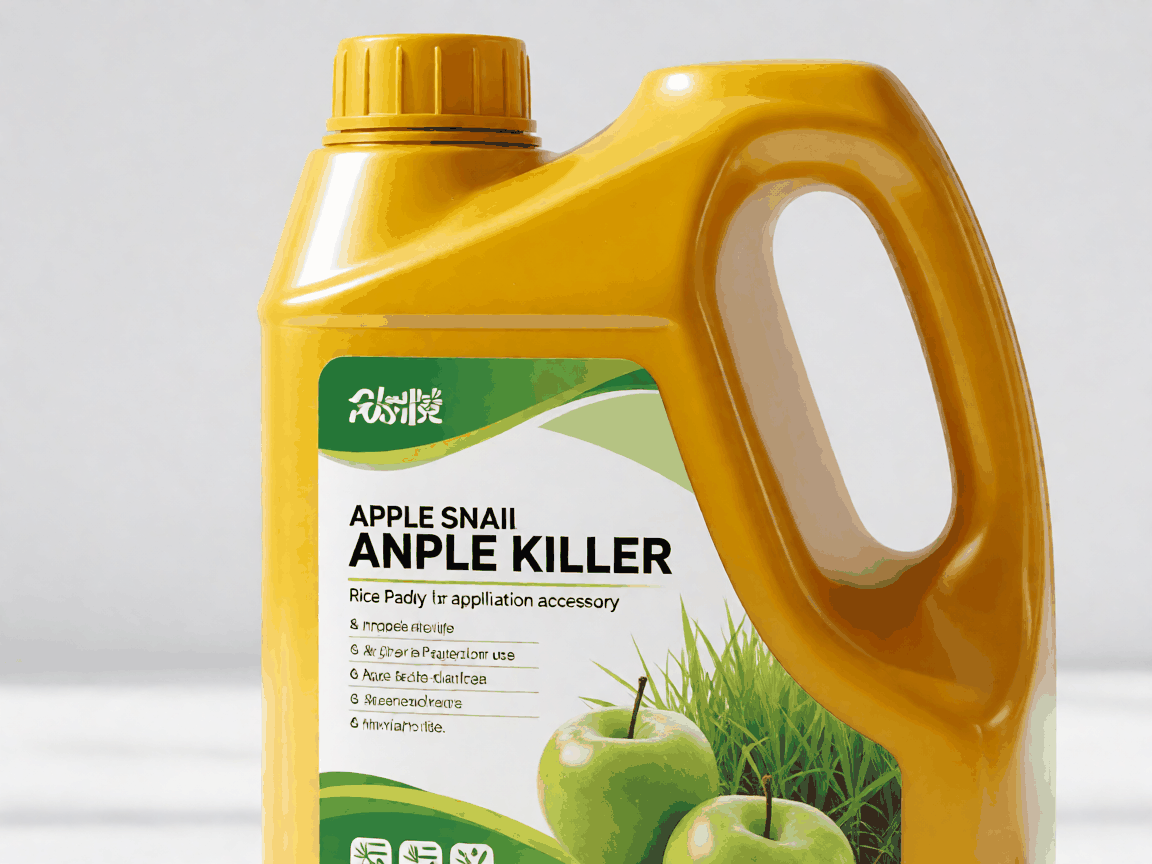
china golden apple snail killer for rice paddies supplier - Bulk Supply and Specification Guide
How It Is Built and What That Changes
First-article tooling determines the baseline efficacy of the formulation. If the grinding mill fails to achieve a particle size below 40 mesh, the active ingredient remains trapped inside the plant-based carrier, drastically reducing water solubility in flooded paddy conditions. We source rice hull or soybean meal as the base matrix, which provides natural adhesion to water and prevents rapid dissolution that would cause environmental runoff issues. The active component, typically a plant-derived alkaloid or approved synthetic analog, is blended under vacuum to ensure uniform distribution without heat degradation.
Critical Formulation Trade-Off
Higher concentration of active ingredient increases per-unit cost by 12-18% but allows for 20-30% less volume applied per hectare. For private-label buyers targeting export markets with strict residue limits, the lower-concentration, high-volume application model is often the safer compliance route, despite the higher logistics weight.
Consistency is set at the forming stage. We do not use loose powder for this specific application profile; instead, the mixture is compressed into pellets or granules using a ring-die extruder. This physical form controls the release rate over 72-96 hours, which aligns with the typical lifecycle of the golden apple snail (GAS) in a single rice season. If the pellet density varies by more than 5% across a batch, the disintegration rate in water becomes unpredictable, leading to either early failure or prolonged exposure that risks non-target aquatic life.
Customisation Options and Their Limits
Process choice shows up later as compliance risk or retail advantage. You can request specific active ingredient ratios, but you cannot alter the base carrier without re-validating the entire solubility profile. The carrier must absorb water to release the active agent; if you substitute a hydrophobic filler to cut costs, the product will float and fail to reach the snails on the mud. We offer three standard carrier grades, each with distinct moisture absorption rates suitable for different irrigation depths.
Standard Carrier (Rice Hull)
Best for shallow water (5-10cm). Low cost. Absorbs water in 4-6 hours. Suitable for general domestic markets.
Premium Carrier (Soybean Meal)
Higher protein content acts as a mild attractant. 8-10 hour absorption. Costs 15% more. Preferred for export to Southeast Asia where snail populations are dense.
Branding customization is limited to the outer packaging, not the product form. The pellet size is standardized at 3-5mm diameter to fit standard handheld applicators used by farm workers. If you require a different pellet size, you must specify the target application method (broadcast vs. targeted spotting) during the sampling phase, as this changes the mold configuration and incurs a one-time tooling fee.
Volume Planning and Lead Time
Buyers often underestimate the time required for stability testing. For OEM orders exceeding 500kg, we require a 14-day accelerated stability test (40°C, 75% RH) before mass production begins. This is non-negotiable to ensure the active ingredient does not degrade during the hot season storage period in the destination country. Skipping this step to save two weeks of lead time results in a higher return rate from expired or weakened stock, which erodes the margin you saved on upfront production time.
| Usage Condition | Typical Failure Mode | Preventive Specification |
|---|---|---|
| Storage in high humidity (>80% RH) | Premature disintegration of pellets; loss of active ingredient before application. | Use of aluminum-lined inner bags; desiccant packs (50g per 20kg unit). |
| Application in fast-flowing water (>5cm/s) | Product washes away before contact; zero efficacy. | Increase pellet density by 10% via binder addition; specify "High-Flow" variant. |
| Batch-to-batch variation in active concentration | Inconsistent kill rates; farmer complaints and brand trust loss. | HPLC testing on 3 random lots per 1000kg batch; tolerance ±5%. |
Export Packaging and Handling Protection
The product is hygroscopic. During sea freight, condensation inside the container is the primary enemy of product integrity. We pack the pellets in 1kg or 5kg inner bags, each sealed with a heat-welded liner that provides a moisture barrier rating of 1.5g/m²/24hr. These inner bags are then placed in outer cartons. The outer carton structure is critical: a 5-layer corrugated board with a bursting strength of at least 12kN/m² is required to withstand stacking in 20ft containers where the load can exceed 25 layers high.
For private-label buyers, we can print the outer cartons with your brand logo and usage instructions in local languages. However, ink coverage must not exceed 40% of the carton surface area. Excessive ink traps moisture and weakens the paper fibers, leading to corner crush failures during unloading. If your design is complex, we recommend using a label sticker on a plain white carton rather than full-wrap printing, which adds 12% to the packaging cost but ensures structural integrity.
Setup, Use and Replacement Parts
There are no "replacement parts" in the mechanical sense, but there is a critical setup step: calibration of the application rate. The label must clearly state grams per square meter, not just "spread evenly." We provide sample labels in English, Mandarin, Vietnamese, and Thai. If you are targeting a market where local language labels are mandatory for retail sale, you must provide the translated text before the pre-production sample is approved. We do not offer translation services, as legal liability for pesticide instructions falls on the importer.
Users report that the product works best when applied 3-5 days before peak snail activity, which correlates with the first heavy irrigation cycle. If the product is applied on dry land, it will not activate. The label must explicitly state "Apply only to flooded fields." This instruction is a key driver of user satisfaction; ignoring it leads to the perception that the product is weak, which is a manufacturing and labeling failure, not an efficacy failure.
Artwork and Branding Review
To begin the OEM process, we require a review of your proposed artwork and label copy. Please ensure that all active ingredient names, concentrations, and safety warnings match the regulations of your destination country. We will provide a digital proof of the packaging within 3 days of receiving your files. Once approved, the pre-production sample lead time is 10-15 days. Mass production follows within 20-25 days after sample sign-off. For volume inquiries or to submit your artwork for review, please contact our sales engineering team.



