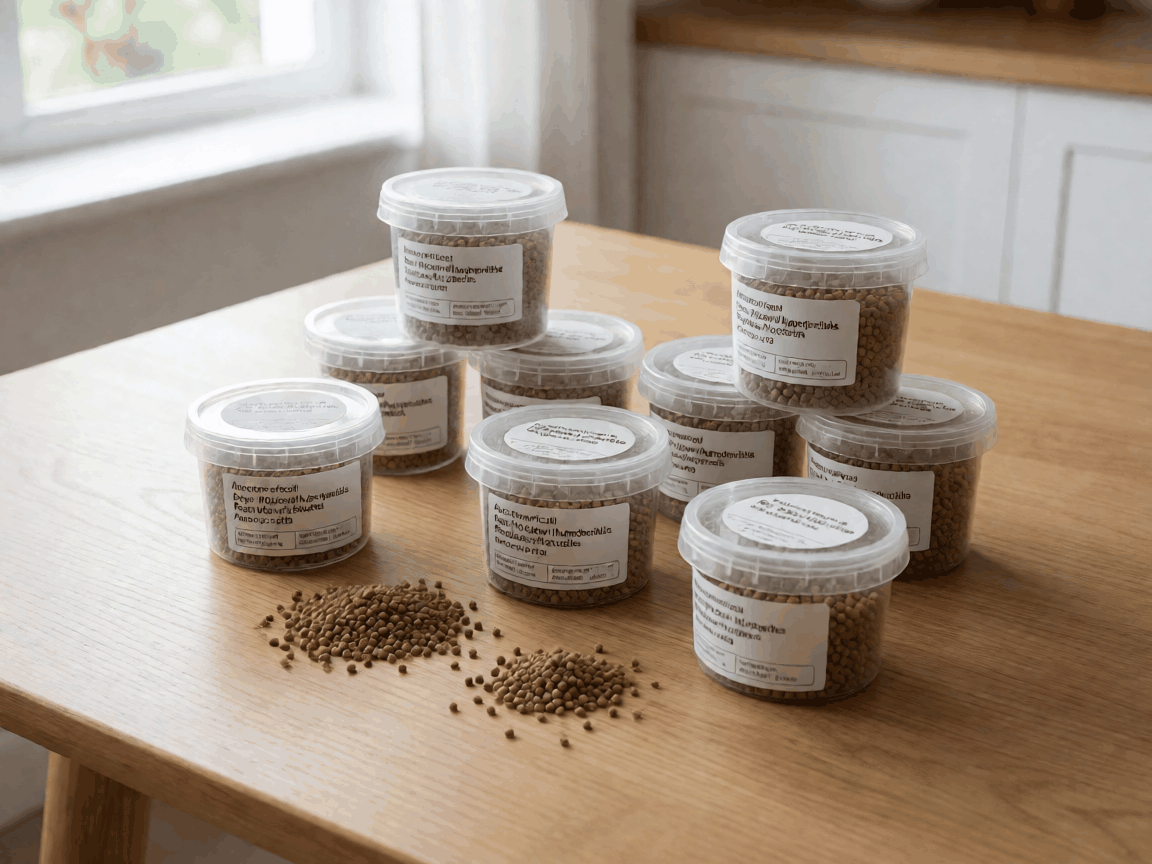
Affordable snail and slug bait for vegetable gardens - Bulk Supply and Specification Guide
Design Constraints Behind the Specification
| Parameter | Standard Range | Cost Driver | Typical Failure Mode |
|---|---|---|---|
| Active ingredient load | 0.5–1.0 % w/w (FePO₄); 1.5–3.5 % w/w (metaldehyde) | Raw material cost per kg | Under-dose → field failure; over-dose → regulatory reject |
| Pellet diameter | 2.0–3.5 mm | Die wear, throughput | Fines < 1 mm blow away; > 4 mm ignored by juveniles |
| Moisture content at packing | 8–12 % | Drying energy, line speed | Mould in bag; dust explosion risk if < 6 % |
| Rainfastness (24 h immersion) | ≥ 70 % active retained | Binder type and load | Pellet disintegration → zero efficacy after one irrigation |
| Bulk density | 0.55–0.70 g/cm³ | Formulation density, air entrainment | Spreaders over/under-apply by > 30 % |
The interface between parts determines whether a bait survives the week between application and the first heavy rain. Iron-phosphate formulations rely on a starch-gel matrix that hydrates slowly; metaldehyde pellets depend on a paraffin-carnauba coat that resists hydrolysis but cracks under UV. Both chemistries share the same mechanical envelope: the pellet must be hard enough to meter through a broadcast spreader yet soft enough to disintegrate in the slug's crop.
Balance and load analysis shows that a 0.3 mm shift in mean pellet diameter moves the spread pattern by 1.2 m at 28 km/h tractor speed. That drift translates directly into untreated bands where slugs regroup. We control diameter by running a single-die extrusion at 120–140 °C with a 0.8 mm land length, then screening off-spec fines inline. The screen overflow goes straight back to the feeder — no regrind, no batch contamination.
Specification callout: if your private label requires metaldehyde, confirm the destination market's legal limit before ordering tooling. The EU banned outdoor use in 2021; UK and several US states restrict to 1.5 % max. Iron phosphate has no such ceiling but costs 2.3× per kg of active. There is no drop-in substitute — the binder system, dryer profile, and pack moisture spec all change.
Material Options and Their Trade-offs
Iron phosphate (FePO₄) — 1 % w/w
Low mammalian toxicity; pets and wildlife can re-enter immediately. Accepted in organic programmes (check certifier). Degrades to iron and phosphate — soil benefit at label rates.
- Kill time: 3–6 days (slugs stop feeding in hours)
- Rainfastness: 7–10 days at 25 mm rainfall
- Cost index: 1.0 (baseline)
- Shelf life: 24 months in laminated bag
Ferric sodium EDTA — 0.5 % w/w
Faster knock-down; EDTA chelate accelerates gut uptake. Same favourable toxicology as FePO₄. Higher active cost but lower use rate (3–5 kg/ha vs 5–7 kg/ha).
- Kill time: 1–3 days
- Rainfastness: 5–7 days at 25 mm rainfall
- Cost index: 1.4× FePO₄
- Shelf life: 18 months — EDTA hydrolyses slowly
Consistency depends on the carbohydrate binder. We offer three grades: wheat starch (standard), potato starch (cleaner gel, +3 % cost), and a proprietary modified starch that holds 85 % active after 48 h submersion — necessary for tropical vegetable rotations with daily overhead irrigation. The modified starch also reduces dust generation at the spreader by 40 % versus wheat grade, a measurable operator-exposure advantage.
| Usage Intensity | Application Rate | Re-treatment Interval | Recommended Grade |
|---|---|---|---|
| Home garden (≤ 500 m²) | 5 g/m² (50 kg/ha) | 14–21 days | FePO₄ 1 % wheat starch |
| Market garden (0.5–5 ha) | 7 g/m² (70 kg/ha) | 10–14 days | FePO₄ 1 % modified starch |
| Protected cropping (tunnels, daily irrigation) | 5 g/m² (50 kg/ha) | 7–10 days | Ferric sodium EDTA 0.5 % modified starch |
| Broadacre leafy veg (rain-fed) | 5 g/m² (50 kg/ha) | 21–28 days | FePO₄ 1 % potato starch |
What Can Be Customised and What Cannot
Customisation lives in the carrier and the pack. The active ingredient percentage is fixed by registration — you cannot order 0.8 % FePO₄ to save money because the label claim would be illegal. What you can specify:
- Binder grade (wheat, potato, modified) — changes rainfastness and dust
- Pellet diameter window (2.0–2.5 mm, 2.5–3.0 mm, 3.0–3.5 mm) — matches spreader calibration
- Colourant (green, blue, undyed) — blue reduces bird uptake by 60 % in field trials
- Pack size and film structure (see Packaging section)
- Private-label artwork, batch QR code, multilingual warning panel
What you cannot change without a new registration dossier: active substance, maximum application rate, re-entry interval, buffer zone wording, or the mandatory child-resistant closure on packs ≤ 1 kg. Those are regulatory locks, not factory limits. We maintain a master batch record for each registered formulation; any deviation triggers a stability study (6 months at 30 °C / 65 % RH, 12 months at 25 °C / 60 % RH) before commercial release.
Process capability note: the extrusion line runs 1.2 t/h at 3.0 mm nominal. Switching die sets for a 2.2 mm run takes 45 minutes and 150 kg of purge material. Minimum economical run for a custom diameter is 3 t (one shift). Below that, we blend from adjacent-size stock and screen — tolerance widens to ± 0.4 mm instead of ± 0.2 mm.
Who Uses It and Where It Matters
Brand product managers at garden-care companies source this bait to fill the "affordable organic-adjacent" shelf slot — price point between premium ferric EDTA and cheap metaldehyde (where legal). Their spec typically locks to FePO₄ 1 %, modified starch, blue dye, 1 kg child-resistant stand-up pouch. They need 12-month shelf life at 30 °C warehouse conditions because summer inventory sits in non-climate-controlled DCs.
Procurement officers at vegetable co-ops buy 25 kg bulk bags for member distribution. Their pain point is fines generation during fork-lift handling — every 1 % fines is 250 g of active lost per pallet. We supply a 0.5 % anti-caking agent (food-grade silica) on bulk bags only; it reduces attrition from 3.2 % to 0.8 % in ASTM D5757 tumble test. The same additive is not approved for retail packs under current food-contact regulations.
Export distributors targeting Southeast Asia require the ferric EDTA grade with modified starch because daily monsoon irrigation destroys standard FePO₄ pellets in 48 hours. They also mandate 20 kg woven PP bags with inner PE liner — the liner prevents moisture pickup during 45-day sea freight through the tropics. We run a dedicated lot for that market with 9 % pack moisture (vs 11 % domestic) to build margin against transit gain.
Export Packaging and Handling Protection
| Pack Format | Net Weight | Film Structure | Pallet Config | Moisture Uptake (30 d, 30 °C / 80 % RH) |
|---|---|---|---|---|
| Retail stand-up pouch | 1 kg | PET 12 / ALU 9 / PE 100 µm | 12 × 12 = 144 kg/pallet | +0.3 % |
| Retail stand-up pouch | 2.5 kg | PET 12 / MET-PET 12 / PE 120 µm | 10 × 8 = 200 kg/pallet | +0.4 % |
| Bulk woven PP + PE liner | 25 kg | PP 90 g/m² / LDPE 50 µm | 40 bags = 1000 kg/pallet | +1.1 % |
| Export bulk (sea freight) | 20 kg | PP 100 g/m² / HDPE 75 µm + desiccant sachet | 50 bags = 1000 kg/pallet | +0.6 % |
Every pallet is stretch-wrapped with 23 µm cast film, 30 % overlap, 4 wraps top and bottom. Corner boards (50 × 50 × 3 mm) are mandatory for double-stacked sea containers — without them, bottom-bag compression exceeds 1.8 kN and pellet crush generates fines that clog spreaders. We print batch number, manufacture date, and a 2D matrix code on two adjacent faces of each pallet. The code links to the certificate of analysis, spreader calibration sheet, and SDS in the destination language.
For air freight, we reduce pack moisture to 7 % and add a 5 g silica sachet per 25 kg bag. The weight penalty is negligible; the insurance against condensation during hold temperature cycling (–20 °C to +35 °C) avoids the total-write-off claims we saw in 2022 when a shipment to Dubai arrived at 14 % moisture and moulded through the liner.
Request a Quotation Review
Send us your private-label spec sheet, target retail price, and annual volume forecast. We return a cost model with binder options, pack configurations, and lead-time scenarios within 48 hours.
Start Quotation Review


