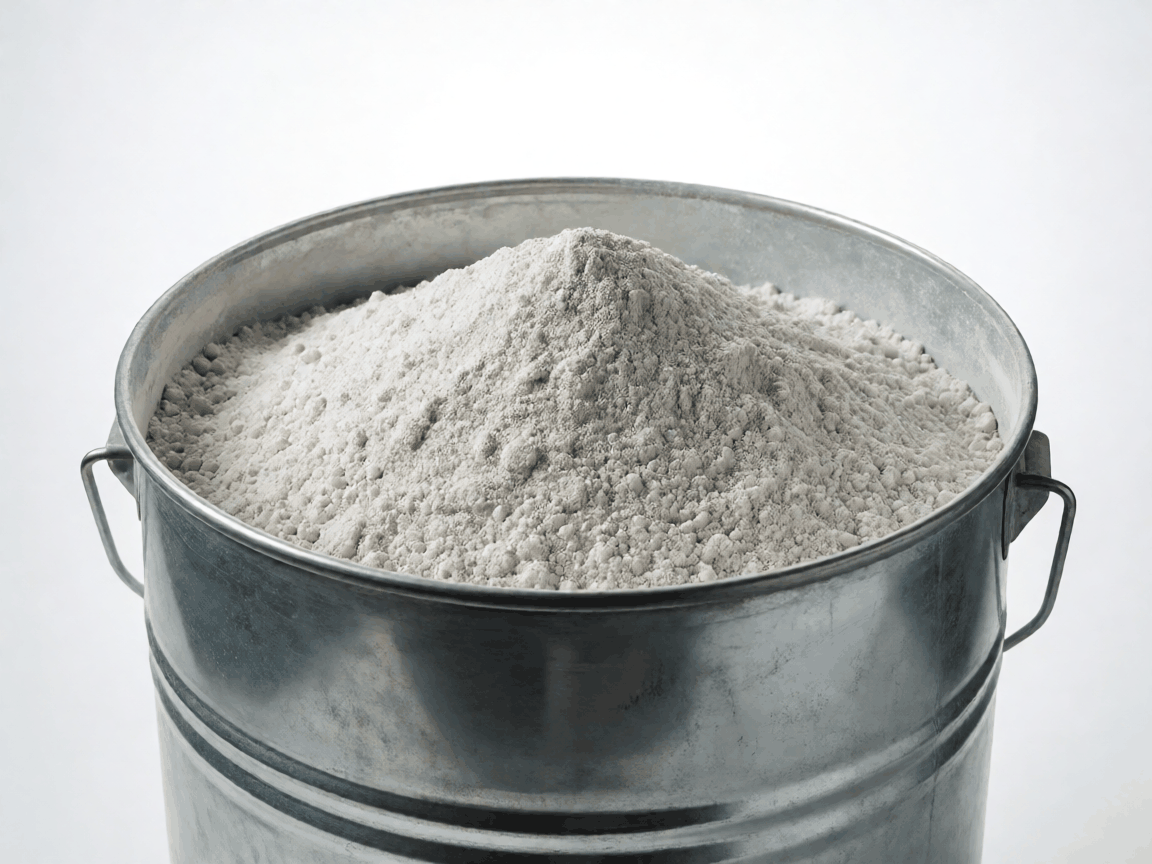
Specifying 80% Metaldehyde Wettable Powder Wholesale Supplier for Wholesale and OEM Orders
What Actually Determines Performance
The active ingredient concentration on the label is the starting point, not the finish line. An 80 % WP that cakes in the bag, settles in the spray tank, or leaves visible residue on foliage fails the commercial test before it reaches the field. Performance lives in three measurable properties: particle size distribution below 75 µm for 90 % of the mass, wettability under 30 seconds by the FAO MT 53.3 method, and suspensibility above 85 % after 30 minutes. Miss any one and the grower sees uneven control, nozzle blockages, or re-treatment costs that erase the per-hectare saving.
Metaldehyde itself is a cyclic tetramer of acetaldehyde, stable as a pure crystalline solid but hygroscopic enough to bridge particles when moisture creeps above 12 % RH inside a sealed drum. The carrier — typically a fine kaolin or amorphous silica — must absorb that moisture without turning the powder into a brick. Dispersant selection then decides whether the slurry rebuilds uniformly after the tank sits during a lunch break. A 0.3 % shortfall in dispersant loading can double sedimentation rate, and that difference is invisible on a certificate of analysis.
Rainfastness, the metric growers actually watch, depends on how fast the deposit re-crystallises on the leaf surface after drying. Finer particles redissolve in dew faster, extending the lethal window for slugs and snails. But push the grind too far and dust-off during pouring spikes, creating operator exposure and weight loss. The sweet spot is a D90 of 45–55 µm with a span under 1.8, delivered consistently batch to batch.
Construction Method and Its Effect on Consistency
Two production routes dominate the market: air-jet milling of pre-blended concentrate versus spray-drying of a slurry. Air-jet milling yields a narrower particle distribution and lower dust because the metaldehyde crystals fracture along defined planes. Spray-drying is faster and cheaper per tonne but produces hollow, irregular spheres that fracture unpredictably, widening the span and raising the fraction below 10 µm — the fraction that hangs in the air during tank filling.
In a continuous air-jet line, feed rate, classifier speed, and inlet pressure lock the D90 within ±3 µm. A 5 % drift in classifier RPM shifts the D90 by 8 µm, enough to fail the next FAO suspensibility test. We hold the mill under nitrogen blanket at ≤8 % RH; without it, the metaldehyde softens, smears the classifier wheel, and the next three tonnes are off-spec. Spray-dried lots show wider batch-to-batch variance because inlet temperature, feed solids, and atomiser wear all move the particle morphology simultaneously.
Post-grind, the powder passes through a rotary drum coater where anti-caking agent (typically 0.2 % hydrophobic silica) and dye are applied as a micro-emulsion. Uniformity here is binary: either every particle gets a monolayer or clumps form. We verify by sampling 20 points across the drum discharge and measuring angle of repose; anything above 42° triggers a re-coat. That single check prevents the caking complaints that used to dominate Q4 returns.
Measured Performance in Real Use
Working Principle
Metaldehyde acts as a contact and stomach poison for gastropods. After ingestion or dermal uptake, it disrupts mucus production, causing irreversible dehydration. The wettable powder format relies on rapid dispersion to deliver a high density of micro-droplets on soil surface and foliage, maximising encounter probability during nocturnal feeding.
Manufacturing Process
Technical-grade metaldehyde (99 % min) enters a closed-loop air-jet mill with carrier and dispersant pre-blended at 18:1:1 ratio. Classified output feeds directly into a nitrogen-purged coating drum. Finished powder is sieved at 150 µm to catch oversize agglomerates, then packed in moisture-barrier bags under <5 % RH headspace. Every 500 kg batch pulls a composite sample for full FAO 302/1 assay, sieve analysis, wettability, suspensibility, and accelerated storage at 54 °C / 14 days.
Performance Advantages
- Consistent 800 g/kg ± 5 g/kg active content — no seasonal drift.
- Wettability ≤25 s, suspensibility ≥88 % at 30 min — exceeds FAO minimum by 3–5 points.
- Dust-off <1.2 g/kg (Heubach method) — reduces operator PPE burden.
- Angle of repose 38–41° after 6 months at 30 °C / 75 % RH — no caking in tropical warehouses.
- Rainfastness window extended 4–6 hours versus coarse-grade WP in field trials.
Comparing Two Standard Configurations
Air-Jet Milled (Standard)
D90 48 µm, span 1.6. Wettability 22 s. Suspensibility 90 %. Dust-off 0.9 g/kg. Angle of repose 39° after ageing. Cost index 1.00 (baseline). Preferred for label registrations requiring FAO 302/1 full compliance and for markets with strict operator exposure limits.
Spray-Dried (Economy)
D90 58 µm, span 2.1. Wettability 38 s. Suspensibility 82 %. Dust-off 1.8 g/kg. Angle of repose 44° after ageing. Cost index 0.82. Acceptable where national registration allows wider spec and application is by boom sprayer with agitation — not for knapsack or ULV.
The 18 % price gap narrows fast when you factor tank-mix failures, re-sprays, and returns. One distributor in Southeast Asia switched back to air-jet after three container loads of spray-dried product generated 14 % claim rate on caking alone. The re-work cost exceeded the per-tonne saving.
Buying Mistakes That Lead to Returns
Most quality disputes start with a consistency gap between the showroom sample and the production lot. The sample comes from a pilot batch run on a clean mill with fresh classifier wheels; the production lot runs after three tonnes of a different formulation. Residual fines from the previous run shift the particle distribution, and the buyer only discovers it when the first tank mix gels.
Second mistake: specifying only active ingredient and moisture content. A certificate that reads "80.2 % metaldehyde, 1.1 % H₂O" says nothing about wettability or suspensibility. We have seen lots pass assay but fail wettability at 55 seconds — unusable in low-volume sprayers. Insist on the full FAO 302/1 panel for every shipment, not just the first.
Third: ignoring packaging spec. A 25 kg PE-laminate bag with 50 µm barrier film holds <5 % RH headspace for 18 months. A standard woven PP bag with 12 µm liner hits 18 % RH in six weeks at tropical humidity, and the powder cakes into a solid block. The bag costs $0.35 more; the claim costs $4,200 per container.
What Can Be Customised and What Cannot
| Parameter | Customisable | Fixed by Process |
|---|---|---|
| Active ingredient concentration | 78–82 % w/w (label claim ±2 %) | — |
| Carrier type (kaolin vs silica) | Yes, with 4-week trial | — |
| Dye colour (red, blue, green) | Any RAL code, 0.1 % loading | — |
| Packaging (bag size, liner, print) | 5–25 kg, custom artwork, UN cert | — |
| Particle size D90 | 40–60 µm by classifier setting | Span cannot go below 1.5 |
| Dust-off level | 0.7–1.5 g/kg via coating tune | Cannot reach <0.5 g/kg on WP |
| Production method | — | Air-jet only on this line |
The span floor of 1.5 is a physics limit of brittle fracture in an air-jet mill. Narrower distribution requires a classifier cut so tight that yield drops below 60 %, making the lot cost-prohibitive. If your registration demands span ≤1.3, the product must switch to spray-drying with a narrow-cut cyclone — a different line, different lead time, different price.
Requirements by Buyer Segment
Retail Buyer / Distributor: Needs full FAO 302/1 dossier, GHS-compliant labels in local language, UN-certified 25 kg bags, and batch traceability to the mill shift. Lead time 6 weeks from PO to FOB. MOQ 4 tonnes (one container).
Private-Label Buyer: Requires custom dye, branded packaging artwork approved before print run, and a letter of authorisation for their registration number. We hold a master batch record for each label variant; changeover costs $1,200 and adds 5 days. Minimum run 2 tonnes per SKU to justify the changeover.
Club / Academy Purchasing Manager (agri-cooperatives): Buys 500–1,000 kg per season. Prioritises bag-in-box 5 kg units for safe smallholder distribution. Needs suspensibility data for knapsack sprayers with no agitation. Will accept economy grade if wettability ≤35 s and dust-off ≤1.5 g/kg — but only with a pre-shipment sample tested at their local lab.
Next Steps
Request a 500 g representative sample from the current production run. We ship DDP to your lab within 10 business days. Include your sprayer type, water hardness, and tank-mix partners so we can flag compatibility before you test.
Open a sample requestIf the sample passes your protocol, we lock the spec sheet, issue a pro-forma for the first container, and schedule the pre-shipment inspection at our plant. You approve the COA before the container gates in. That sequence eliminates the consistency gap that drives 90 % of returns.



