broad spectrum glufosinate herbicide supplier: Specification, Ordering and Quality Notes
The main trade-off sits between active ingredient purity and formulation stability. A 200 g/L soluble concentrate demands tighter impurity control than a 150 g/L grade — specifically MPP and NAG below 0.5 g/kg each — but the higher load reduces freight cost per hectare. Buyers qualifying a second source should lock the impurity specification in the technical agreement before pilot batches run, not after commercial lots ship.
How It Performs in Use
Process choice shows up later as tank-mix compatibility and rainfastness consistency. The phosphinothricin synthesis route — whether from triethyl phosphite or the newer continuous-flow phosphatation — determines the chiral purity of the L-isomer, which directly drives herbicidal speed on resistant amaranth and ryegrass populations.
Formulation stability hinges on the surfactant package and pH buffer system. A typical 150–200 g/L SL uses alkyl naphthalene sulfonate dispersants at 3–5 % w/w with a citrate-phosphate buffer holding pH 6.5–7.5. If the buffer capacity drops below 15 mmol/L per pH unit, the concentrate gels within 30 days at 40 °C accelerated storage. That gel does not redisperse — it blocks nozzles and forces field recalls.
Size, Weight and Specification Range
| Parameter | Standard Range | Typical Test Method |
|---|---|---|
| Active ingredient content | 150 g/L or 200 g/L ± 5 g/L | HPLC (CIPAC 470/1) |
| MPP impurity | ≤ 0.5 g/kg (200 g/L grade) | GC-FID (CIPAC 470/2) |
| NAG impurity | ≤ 0.5 g/kg (200 g/L grade) | GC-FID (CIPAC 470/2) |
| pH (1 % dilution) | 6.5 – 7.5 | Potentiometric (MT 75.3) |
| Density at 20 °C | 1.12 – 1.18 g/mL | Oscillating U-tube (MT 3.3) |
| Persistent foam (1 min) | ≤ 20 mL | CIPAC MT 47.2 |
| Wet sieve test (75 µm) | ≤ 0.1 % | CIPAC MT 185 |
| Accelerated storage (14 d @ 54 °C) | AI loss ≤ 2 %; no sediment | CIPAC MT 46.3 |
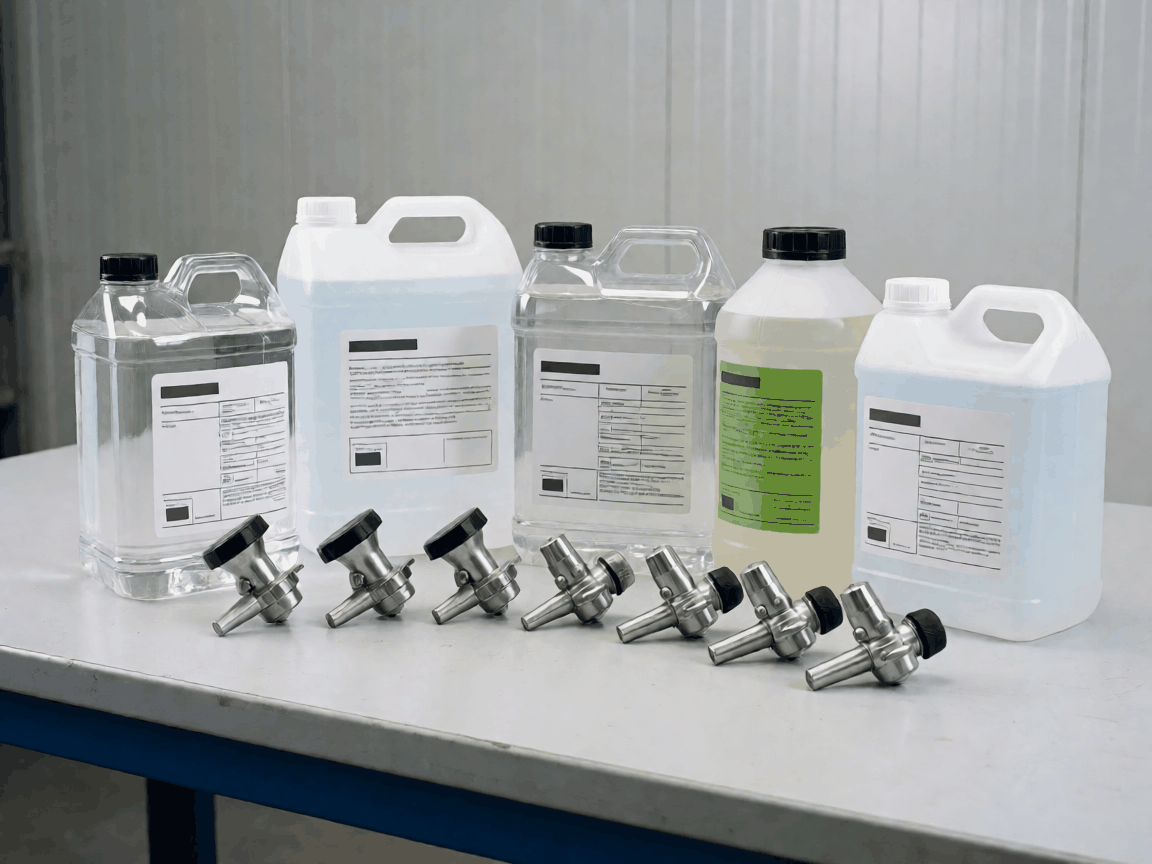
Packaging weight drives the freight calculation. A 20 L HDPE jerrican with UN 1A1/Y1.6/150 approval weighs 950 g empty; a 1000 L IBC with UN 31HA1/Y/150 approval weighs 58 kg empty. Both require vented caps with PTFE liners to prevent paneling during temperature cycling.
Assumptions Buyers Should Stop Making
The build method decides whether the 200 g/L grade stays in solution through a Chinese winter. Some suppliers cut the surfactant load by 15 % to save cost, then compensate with co-solvents that evaporate through the vented cap over six months. The result is a concentrate that passes QC at release but crashes out at 5 °C in the distributor's warehouse.
Another common error: treating the FAO specification as a ceiling rather than a floor. FAO allows MPP up to 5 g/kg; competent manufacturers target ≤ 0.5 g/kg because MPP photodegrades to N-phosphonomethylglycine, which accumulates in rotational crops. If the technical agreement only references FAO limits, the buyer has no contractual leverage when the impurity spikes at 3 g/kg in year two.
Consistency is set at the forming stage — specifically the microemulsion pre-mix step. The order of addition (surfactant into water, then AI, then buffer) and shear rate (1200–1500 rpm for 20 min) fix the droplet size distribution. A 10 % shift in shear time moves the D90 from 180 nm to 340 nm, which doubles the sedimentation rate in accelerated storage. Pilot batches must replicate the commercial homogenizer geometry, not just the RPM.
Quality Control and Batch Consistency
Release Testing Protocol
Every commercial lot undergoes the full CIPAC suite: AI content by HPLC, MPP/NAG by GC-FID, pH, density, foam, wet sieve, and a 14-day 54 °C accelerated storage. The certificate of analysis includes the chromatograms for AI and impurities — not just the summary table — so the buyer can verify integration parameters.
Stability Monitoring
Retention samples (3 × 1 L per batch) are stored at 25 °C ± 2 °C and 40 °C ± 2 °C. The 25 °C set is pulled at 6, 12, 18, and 24 months for full re-analysis. The 40 °C set confirms the 14-day prediction at 3 and 6 months. Any deviation > 1 % AI loss or > 0.2 g/kg impurity increase triggers a root-cause investigation and customer notification within 10 business days.
Traceability
Batch numbers encode: synthesis campaign (two digits), formulation week (two digits), filling line (single letter), and sequential fill number (four digits). This links the final drum back to the specific reactor charge and surfactant lot. Buyers auditing the facility can request the full genealogy report — reactor temperatures, feed rates, in-process HPLC checkpoints — for any delivered lot.
Capacity, Tooling and Scheduling
The formulation suite runs two 15 m³ jacketed vessels with inline homogenizers (Rotor-Stator, 3000 rpm tip speed). Filling lines: one 20 L jerrican line (1200 units/hour), one 200 L drum line (180 units/hour), one IBC line (40 units/hour). All lines share a common CIP circuit with validated cleaning between campaigns — critical because glufosinate residues below 5 ppm cross-contaminate subsequent sulfonylurea formulations.
Lead time for a first commercial order: 10 weeks from technical agreement sign-off. That breaks down as two weeks for raw material qualification (surfactant lot, buffer salts), three weeks for pilot batch (500 L) and accelerated storage, two weeks for buyer sample evaluation, and three weeks for commercial fill once the purchase order lands. Repeat orders from qualified lots: 4 weeks ex-works.
Capacity ceiling: 1,200 metric tons AI equivalent per year on a 24/5 shift pattern. The bottleneck is the synthesis reactor (8 m³, batch cycle 36 hours), not the formulation or filling lines. Buyers forecasting > 300 t/year should discuss dedicated reactor allocation 12 months ahead.
Export Packaging and Handling Protection
Maritime shipments use 20 L jerricans on CP3 pallets (1140 × 1140 mm), four layers of 12 units, stretch-wrapped with 23 µm UV-resistant film. Each pallet carries a shockwatch 25G indicator and a temperature logger (recording at 30-minute intervals). IBCs ship in 20-ft containers, four per container, braced with inflatable dunnage bags rated to 1.5 g lateral acceleration.
Labels comply with GHS Rev. 10 and IMDG 41-22: UN 3082, Class 9, PG III, Marine Pollutant. The label artwork must be approved by the buyer's regulatory affairs team before plate-making — a two-week cycle. We hold a library of pre-approved label templates for 18 jurisdictions; custom artwork adds 10 working days to the packaging schedule.
Setup, Use and Replacement Parts
End-users dilute the concentrate 1:200 to 1:400 in spray tanks. The formulation includes a built-in antifoam (modified polysiloxane, 0.15 % w/w) that remains effective at water hardness up to 600 ppm CaCO₃. Above that, a separate tank-mix antifoam is recommended — we supply a compatible 10 % silicone emulsion in 1 L bottles.
Sprayer cleanup: triple rinse with 1 % ammonia solution (pH 11) followed by fresh water. Glufosinate adsorbs to poly tank walls at pH < 5; the alkaline rinse desorbs > 99 % of residues. Nozzle screens (50 mesh) should be cleaned daily during high-volume applications — the wet sieve spec guarantees ≤ 0.1 % > 75 µm, but agglomerates can form if the concentrate freezes and thaws in transit.
Shelf life: 24 months from manufacture date when stored at −10 °C to 35 °C in original sealed containers. Containers opened for partial use should be resealed within 4 hours and used within 30 days — the buffer capacity degrades once headspace CO₂ equilibrates.
Ready to Qualify a Second Source?
Send your current specification sheet and annual volume forecast. We'll return a gap analysis against our process capability within five business days, plus a pilot batch schedule.
Request Technical Agreement TemplateNeed a Tooling Review?
If you're switching packaging formats or adding a new market label, book a 30-minute call with our packaging engineers. We'll confirm UN certification compatibility, label plate lead times, and pallet optimization for your container mix.
Schedule Packaging Review


