agricultural broad spectrum fungicide supplier: What Buyers Should Check Before Ordering
During a private-label launch with a fixed ship date, the formulator discovered that the suspension concentrate they had qualified in 1 L bottles sedimented irreversibly in 200 L totes after three weeks at 35 °C. The root cause was a dispersant package that passed the standard CIPAC suspensibility test at lab scale but could not maintain particle suspension at the higher solids loading required for bulk packaging. The batch had to be reworked, pushing the launch back six weeks and incurring demurrage charges on the tote fleet.
Where Cheaper Alternatives Fall Short
Low-cost suppliers often reduce the dispersant and anti-settling agent load to shave 3–5 % off the formulation cost. That saving disappears when the product cakes in the bag or settles into a hard layer that no amount of shaking redisperses. A water-dispersible granule (WG) that loses 15 % of its active ingredient to dust during handling forces the grower to over-apply, pushing residue levels close to the MRL and triggering retailer rejection.
Specification rule: any WG supplied to us must retain ≥ 98 % of its declared active content after 100 drops from 1.5 m onto concrete (CIPAC MT 174). If the supplier cannot demonstrate that on their pilot line, we do not sign the supply agreement.
Buying Mistakes That Lead to Returns
| Use Condition | Common Complaint | Spec Lock |
|---|---|---|
| High-humidity storage (> 70 % RH) in tropical depots | Granules fuse into clumps; scoopable dose becomes unpredictable | Moisture uptake ≤ 0.5 % w/w after 7 days at 30 °C/75 % RH (CIPAC MT 100) |
| Tank-mix with glyphosate‑based herbicides at 1:100 dilution | Flocculation within 5 min; spray nozzles clog, field efficacy drops | Zeta potential ≤ ‑30 mV in 0.1 % electrolyte; no visible cream after 30 min (CIPAC MT 184) |
| Long‑haul sea freight in non‑reefer containers (peak 45 °C) | Active degrades > 5 %; pH drifts outside 6–8 window, causing crop phytotoxicity | Accelerated storage: ≤ 2 % active loss, pH shift ≤ 0.3 units after 14 days at 54 °C (CIPAC MT 46.3) |
Customisation Options and Their Limits
We can adjust the carrier system (clay vs. silica vs. lignin) to meet a specific dust‑suppression target or to match a co‑formulant’s pH profile. Switching carriers changes the bulk density by 0.15–0.25 g/cm³, which in turn shifts the bag fill weight for a given volume. That shift alters the pallet pattern and the container load plan — often the hidden cost driver.
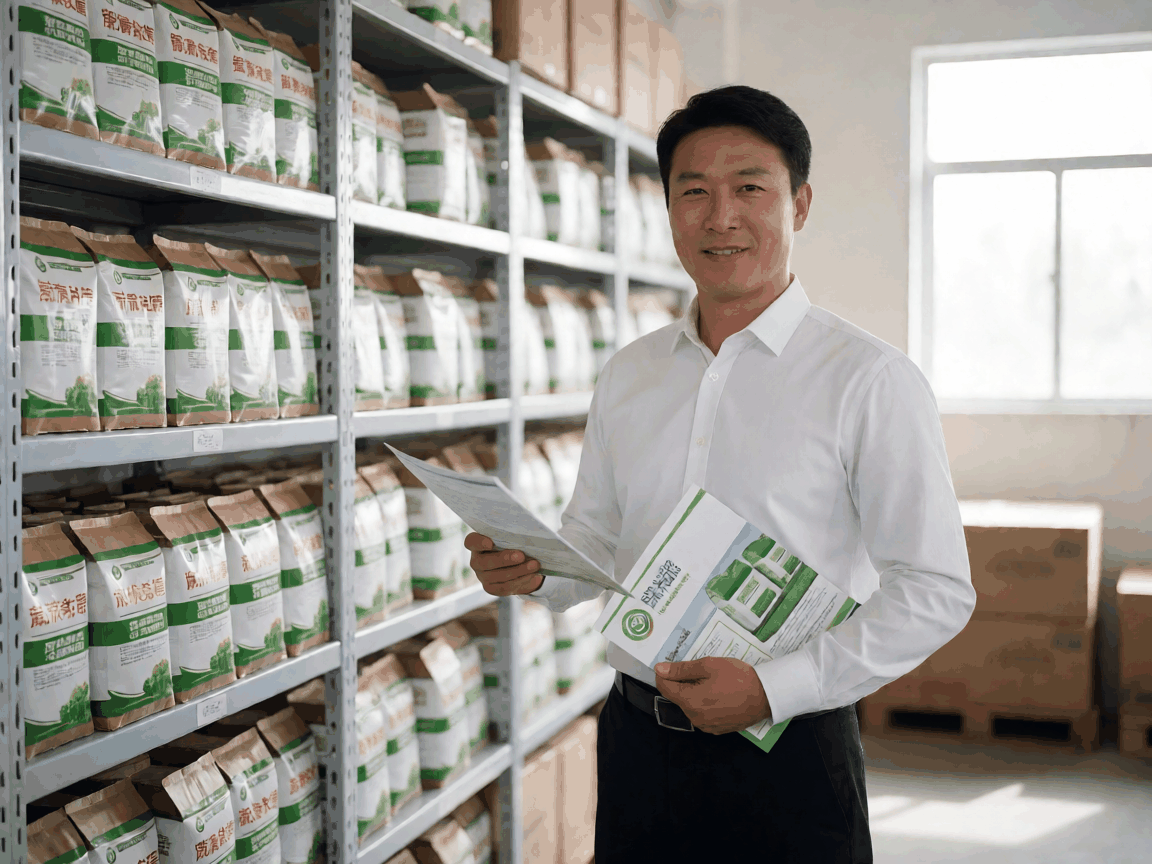
Colour coding is another lever. A 0.5 % w/w pigment addition lets a brand differentiate its SKU on the shelf, but certain iron‑oxide pigments accelerate photo‑degradation of strobilurin actives. We run a 300‑hour Xenon arc test (CIPAC MT 12) on every pigment‑active combination before approving the masterbatch.
Packaging configurations we support
- Water‑soluble bags (PVA, 10 g, 20 g, 50 g) for direct‑in‑tank dosing — eliminates operator exposure and dust.
- Multi‑wall paper/PE laminate sacks (1 kg, 5 kg, 25 kg) with heat‑sealed inner liner — standard for WG, requires pallet stretch‑wrap rated for 1.5 t.
- HDPE bottles (1 L, 5 L) and jerrycans (20 L) with induction‑sealed caps — for SC and EC formulations; UN‑certified for Class 9 transport.
- Returnable 200 L stainless‑steel totes with nitrogen blanket — for high‑value SC batches; deposit managed via our logistics partner.
Who Uses It and Where It Matters
Regional distributors serving vineyards in the Mendoza valley need a WG that survives 40 °C warehouse temperatures and still disperses in hard water (350 ppm CaCO₃). Their growers spray at 0.3 kg/ha with air‑blast sprayers; any nozzle blockage means a lost pass and a phytotoxicity claim.
Large‑scale grain cooperatives in the US Midwest order 200 L totes of SC formulation for custom‑blend facilities. They require a guaranteed 18‑month shelf life at ambient conditions because the blend schedule shifts with commodity prices. A pH drift of 0.5 units in month 14 forces a full re‑qualification of the blend recipe.
Specialty crop advisors in Southeast Asia specify a dust‑free granule for drone‑based ultra‑low‑volume application. The granule must have a span (D90/D10) ≤ 1.8 and a friability index < 2 % so the drone’s rotary atomizer produces a consistent droplet spectrum.
How Consistency Is Held Across Batches
Every production lot passes through a three‑gate release: (1) inline NIR calibration against HPLC reference for active content ± 1.5 %; (2) laser diffraction particle‑size check on a 10 g grab sample — D50 must sit within ± 3 µm of the master batch; (3) 14‑day accelerated storage at 54 °C followed by full CIPAC physical‑property suite. Only lots clearing all three gates receive the batch certificate and the tamper‑evident seal.
We retain a 500 g reference sample from each lot for 36 months in a climate‑controlled archive (25 °C ± 2 °C, 40 % RH ± 5 %). If a field complaint arises, we can run a side‑by‑side comparison against the original spec within 48 hours.
Standard grade
Active purity ≥ 95 %; D50 45 µm ± 3 µm; suspensibility ≥ 85 %; 12‑month shelf life at 30 °C. Suited for regional distributors with climate‑controlled warehousing.
Export grade
Active purity ≥ 97 %; D50 40 µm ± 2 µm; suspensibility ≥ 95 % in 500 ppm hard water; 24‑month shelf life at 35 °C. Includes UN‑certified packaging and full dossier for local registration support.
Next step: align the spec to your supply chain
Send us the target crop, application equipment, storage climate, and packaging preference. We will return a draft technical data sheet with the exact carrier, dispersant, and packaging spec locked — plus a pilot‑batch timeline and MOQ break points.
Start a project discussion


