special inoculant for landscape seedling maintenance suppliers: Specification, Ordering and Quality Notes
What This Product Is and Where It Fits
Most quality disputes start with a consistency gap between the label claim and what actually reaches the root zone. This inoculant is a concentrated microbial preparation — typically 1–5 × 10⁹ CFU/g depending on strain blend — formulated for tank-mix or hydroseeder application on newly installed and established landscape plantings. The target buyer is a wholesale distributor or private-label brand that supplies landscape contractors, municipal arborists, and nursery operations managing 50–500 acre install programs per season.
The product sits between commodity rhizobium powders (single strain, <10⁸ CFU/g, short shelf life) and premium golf-course bio-stimulants (multi-strain, >10¹⁰ CFU/g, cold-chain mandatory). Our formulation targets the 18–24 month ambient shelf-life window at 5–30 °C, with ≥80 % viability retention after 12 months in sealed 10 kg pails. That window matters because landscape distributors rarely have refrigerated warehouse space.
The Problem Buyers Keep Paying For
Returns usually trace back to the same weak point: viability loss during the 60–90 day lag between manufacture and field application. A batch that leaves the plant at 2 × 10⁹ CFU/g can arrive at the job site at 3 × 10⁸ CFU/g if the carrier moisture drifts above 18 % or if pallets sit in a metal container at 40 °C for three weeks. The contractor sees patchy establishment, blames the seed, and the distributor eats the replacement cost.
The second complaint pattern is tank incompatibility. High-salt starter fertilizers (10-52-10 at 5 kg/100 L) or copper-based fungicides can drop viable counts by 90 % in 30 minutes. Buyers who specify this inoculant usually learned that lesson on a 200-tree municipal contract where the first flush died back and the inoculant got the blame.
Specification rule: Carrier moisture must be held at 12 ± 2 % w/w at packing. Every 1 % above 14 % cuts ambient shelf life by roughly 30 days. If your warehouse regularly hits 35 °C, request the low-moisture grade (8–10 %) and accept the 15 % higher unit cost.
Design Constraints Behind the Specification
Three constraints drive every formulation decision: strain compatibility in the carrier, dust generation during pour-in, and label compliance across state registrations. The strain blend — typically two Bacillus species, one Pseudomonas, and a Glomus mycorrhizal propagule — must coexist without antagonism for 24 months. That rules out several high-performing Bacillus strains that secrete lipopeptides inhibitory to Glomus spores.
Dust is a regulatory and worker-safety issue. Fine peat carriers (<150 µm) give excellent viability but create respirable dust clouds when dumped into a 500 L hydroseeder. We specify a 150–400 µm granular clay-peat composite that keeps dust below 2 mg/m³ during pour-in while maintaining ≥85 % viability at 12 months. The trade-off is a 12 % reduction in CFU/g versus milled peat, which the label accounts for by raising the application rate 1.15×.
State registration drives the label language. California and Florida require separate efficacy data packages; Texas accepts the federal EPA 25(b) exemption if all strains are on the approved list. The master label carries the union of all state restrictions — no claim of "drought tolerance" or "disease suppression" unless the specific strain has that state's data package.
Material Options and Their Trade-offs
Peat-Clay Granular (Standard)
150–400 µm, 12 % moisture, 1.8 × 10⁹ CFU/g blended
18–24 month ambient shelf life at 5–30 °C
Low dust, compatible with most hydroseeders, 10 kg pail
Low-Moisture Granular (Hot-Climate)
150–400 µm, 8–10 % moisture, 1.5 × 10⁹ CFU/g blended
24–30 month ambient shelf life at 5–40 °C
15 % cost premium, slightly slower rehydration (5 min vs 2 min)
Liquid Suspension Concentrate
2 × 10⁹ CFU/mL, 12 month refrigerated (2–8 °C)
Zero dust, direct injection into irrigation
Requires cold chain, 20 L drum, 3× freight cost per CFU
The granular formats use a bentonite-peat carrier with 0.5 % food-grade silica anti-caking agent. Liquid format uses a glycerol-based suspending agent (3 % w/v) and 0.1 % xanthan gum for shear stability. All formats exclude talc and graphite carriers — they interfere with Glomus spore germination and are banned in Washington state.
What Can Be Customised and What Cannot
| Parameter | Customisable | Fixed by Registration |
|---|---|---|
| Strain blend composition | Yes — within EPA 25(b) list | No — each strain requires separate data package |
| CFU/g target (granular) | 1.0–2.5 × 10⁹ range | Label must match tested lot |
| Carrier particle size | 100–500 µm window | Dust limit <2 mg/m³ non-negotiable |
| Packaging size | 1 kg, 5 kg, 10 kg, 20 kg pails | Must be UN-certified for microbials |
| Private label artwork | Full customisation | EPA establishment number must appear |
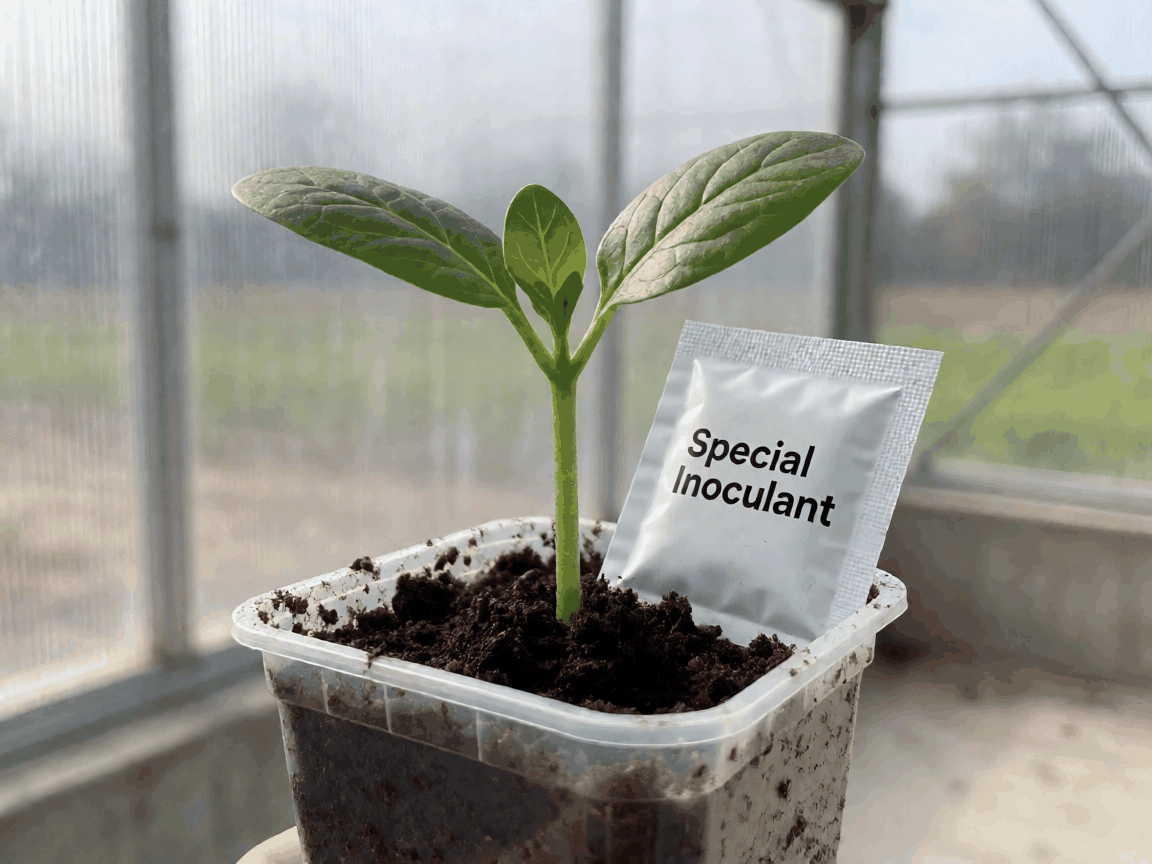
The strain blend is the lever with the most commercial impact. Adding a third Bacillus strain for phosphorus solubilisation adds ~$0.18/kg but requires a new state data package in California (6–9 months, $12–18k). Most private-label buyers stay with the standard four-strain blend and differentiate on carrier grade and packaging.
Usage Scenarios and Buyer Segments
| Buyer Segment | Typical Program | Format Preference | Pain Point Addressed | ||||
|---|---|---|---|---|---|---|---|
| Municipal arborist supply | 200–500 trees/year, spring/fall plantings | Standard granular, 10 kg pail | Shelf life through off-season storage | ||||
| Large landscape contractor | 50–200 acres hydroseeding/year | Low-moisture granular, 20 kg pail | Nursery propagation manager | Container liners, 10⁶–10⁷ units/year | Liquid concentrate, 20 L drum | Injector compatibility, zero dust | |
| Private-label distributor | Resale to independent garden centers | Standard granular, 1 kg & 5 kg retail pails | Brand differentiation, state compliance |
How Consistency Is Held Across Batches
Wear shows up at the same point every season: the 12-month viability assay. We run a three-tier hold program. Tier 1 — every production lot: plate count on selective media for each strain, moisture by Karl Fischer, dust by rotating drum (NIOSH 0600), pH 1:10 water extract. Release window: target CFU ±0.3 log, moisture 12 ± 2 %, dust <2 mg/m³, pH 6.5–7.2.
Tier 2 — quarterly composite: accelerated aging at 35 °C / 75 % RH for 28 days (equivalent to ~12 months ambient), followed by full plate count and Glomus spore germination bioassay on Allium porrum root tips. Tier 3 — annual: full genomic fingerprint (rep-PCR) on each strain to confirm no contamination or plasmid loss. Any lot failing Tier 2 is held for root-colonisation bioassay on the target species (typically Quercus rubra and Picea pungens) before disposition.
Batch traceability links the fermentation run, carrier lot, and packaging shift. The certificate of analysis ships with every pallet and includes the Tier 1 data plus the accelerated aging projection. Private-label buyers receive a co-branded CoA template; the EPA establishment number remains ours.
Ordering, Tooling and Lead-Time Questions
Minimum order and packaging
MOQ is 2,000 kg per formulation (any pack size combination). A 10 kg pail run requires 200 pails; 1 kg retail pails require 2,000 units. Tooling for custom pail moulds (embossed logo, handle colour) is $3,500–$5,000 and adds 3 weeks. Standard plain pails are in stock.
Lead time
Standard blend, standard packaging: 4–5 weeks from PO. Custom strain blend (within EPA 25(b) list): add 2 weeks for fermentation scheduling. New strain requiring state data package: 6–9 months before first commercial lot. Private-label artwork approval: 1 week if files are print-ready (300 dpi, CMYK, dieline matched).
Freight and storage
Granular formats ship ambient, palletised 48 × 10 kg or 24 × 20 kg per pallet, stretch-wrapped with desiccant sachets (2 per pallet). Liquid format ships refrigerated (reefer at 4 °C), 4 drums per pallet. We do not drop-ship to job sites — all freight moves to your warehouse or 3PL. If you need job-site delivery, arrange through your logistics partner; we will palletise to their spec.
Sample approval
We provide 500 g representative samples (standard blend only) at no charge, freight collect. Custom blend samples require a paid pilot run (minimum 200 kg) because fermentation is not scalable below 500 L vessel. The pilot run data becomes the baseline for your commercial CoA.
FAQ
Can I add my own strain to the blend? Only if it is on the EPA 25(b) approved list and you fund the compatibility study (6 weeks, $8–12k). We do not ferment unregistered strains.
What happens if a pallet gets frozen? Granular formats survive freeze-thaw cycles down to -20 °C with <0.2 log viability loss. Liquid format suffers irreversible damage — ice crystals shear spores. Do not let liquid drums freeze.
Is the product OMRI-listed? The standard blend is not. An OMRI-compliant version (organic carrier, no silica anti-caking) is available at 25 % cost premium and 3 log lower CFU/g. Minimum 5,000 kg order.
How do I verify viability at the job site? We supply a field test kit (serial dilution plates, selective media, incubator strips) for $120/kit — 20 tests. It gives a yes/no at 10⁶ CFU/g threshold in 48 hours. Not a replacement for lab CoA, but useful for dispute resolution.
What is the reorder cycle for a typical distributor? Most private-label buyers order quarterly (5,000–15,000 kg) to keep warehouse stock under 90 days. We hold 30 days of your forecasted usage as safety stock at no charge; beyond that, warehousing is $1.20/kg/month.
Ready to Qualify a Second Source?
Send us your current label, target CFU, and annual volume. We'll return a draft specification, pilot run timeline, and landed cost model within 5 business days.
Start a Project Discussion


