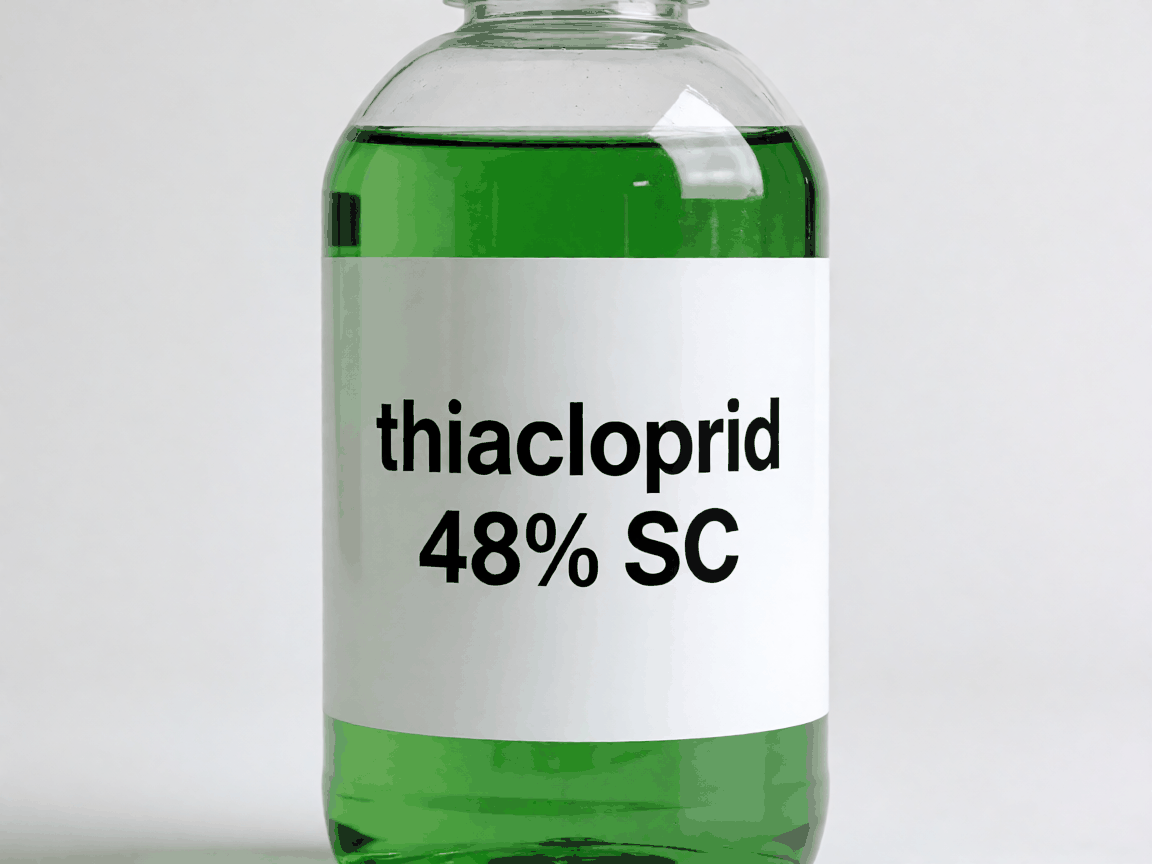
OEM thiacloprid 48% SC suspension concentrate: What Buyers Should Check Before Ordering
What This Product Is and Where It Fits
| Parameter | Standard Range | Buyer Impact |
|---|---|---|
| Active ingredient content | 480 g/L ± 15 g/L (CIPAC MT 175) | Label claim accuracy; regulatory registration hinge |
| Suspension stability (0.05% CMC, 30 min) | ≥ 90% (CIPAC MT 184) | Nozzle blockage risk; tank-mix compatibility |
| Wet sieve residue (75 µm) | ≤ 0.5% (CIPAC MT 185) | Filter clogging; spray uniformity |
| pH (1% dilution) | 4.0 – 7.0 | Crop safety; hydrolytic stability in tank |
| Flash point (closed cup) | > 60 °C | Transport class; warehouse licensing |
Thiacloprid 48% SC belongs to the neonicotinoid class, acting as a nicotinic acetylcholine receptor agonist with systemic and translaminar movement. The suspension concentrate (SC) format keeps the active ingredient as fine solid particles dispersed in water with suspending agents, wetting agents, and antifreeze — critical because thiacloprid's melting point (~139 °C) and low water solubility (~184 mg/L at 20 °C) rule out true solutions. Buyers specifying this grade typically serve row-crop, pome fruit, and ornamental markets where foliar uptake and rainfastness within two hours drive reorder decisions.
Design Constraints Behind the Specification
The first complaint that returns from the field is sediment that will not re-disperse after winter storage. Thiacloprid crystals grow Ostwald-ripening style when the suspension stabilizer — usually a xanthan gum or sodium carboxymethylcellulose matrix — loses yield stress over freeze-thaw cycles. A second failure mode: foam overflow during high-shear induction into spray tanks, caused by excess wetting agent or insufficient defoamer (typically a silicone-polyether copolymer at 0.1–0.3%).
pH drift is the silent killer. Thiacloprid hydrolyzes above pH 8 with a half-life under 24 hours at 25 °C. The buffer system (phosphate or citrate, 0.5–1.0%) must hold the 1% dilution between 4.0 and 7.0 for the entire shelf life. If the buyer's label claims tank-mix compatibility with copper fungicides, the buffer capacity has to absorb the alkaline shift from copper hydroxide without precipitating the suspending polymer.
Specification Trade-off: Freeze Protection vs. Viscosity
Propylene glycol at 5–8% depresses the freeze point to −15 °C but raises low-shear viscosity above 2,000 mPa·s, making pour-out from 20 L jerricans sluggish in early spring. Glycerol at 3–5% gives −10 °C protection with 30% lower viscosity but costs 1.4× more per kilogram. Choose propylene glycol for Central European warehouse turnover; specify glycerol for Nordic or mountain-region distribution where containers sit unheated for months.
How It Is Built and What That Changes
The build method decides particle size distribution, and particle size decides every downstream complaint. Wet bead milling in a horizontal agitated media mill (zirconia beads, 0.8–1.0 mm) targeting D90 < 3 µm and D50 0.8–1.2 µm is the industry baseline. If the mill residence time is cut to boost throughput, the coarse tail (> 5 µm) exceeds the 75 µm sieve limit after three months accelerated storage at 54 °C (CIPAC MT 46.3). That coarse tail settles into a hard cake that no label-rate shaking re-suspends.
First-article tooling determines whether the dispersant (naphthalene sulfonate formaldehyde condensate) adsorbs irreversibly on the crystal face. A two-stage addition — 60% pre-mix with slurry, 40% post-mill — locks the steric barrier before the beads shatter fresh crystal surfaces. Single-shot addition leaves naked surfaces that re-agglomerate in the let-down tank. The let-down sequence itself matters: antifreeze, then buffer, then suspending agent hydrated under low shear for 30 minutes before the milled slurry enters. Reverse the order and the polymer hydrates on the mill heat, losing molecular weight and yield stress.
| Test | Method | Acceptance | Frequency |
|---|---|---|---|
| Active content | HPLC (CIPAC 333/TC/M/3) | 480 ± 15 g/L | Every batch |
| Suspension stability | CIPAC MT 184 | ≥ 90% | Every batch |
| Wet sieve (75 µm) | CIPAC MT 185 | ≤ 0.5% | Every batch |
| Particle size (laser diffraction) | Malvern D90 < 3 µm | D90 < 3 µm | First article + quarterly |
| Accelerated storage (14 d @ 54 °C) | CIPAC MT 46.3 | Pass all physical tests | First article + annual |
| Foam height (0.5% dilution, 30 s shake) | CIPAC MT 47.3 | < 40 mm after 1 min | Every batch |
Where This Product Beats Standard Alternatives
vs. 480 g/L SL (Soluble Concentrate)
SL formulations require cosolvents (NMP, DMSO) to dissolve 48% thiacloprid. Those cosolvents strip cuticular wax, increasing phytotoxicity risk on tender pome fruit varieties (e.g., 'Gala' apple at pink bud). SC avoids cosolvents entirely — rainfastness comes from particle adhesion, not solvent penetration.
SL also carries a UN 3082 transport classification (Environmentally Hazardous Substance, Liquid, N.O.S.) at lower thresholds because the cosolvent increases aquatic bioavailability. SC typically ships as UN 3077 (Solid, N.O.S.) with higher net weight per container.
vs. 24% + 24% WG (Water-Dispersible Granule)
WG requires a granule disintegration step (CIPAC MT 174) that adds 2–3 minutes at the induction hopper. In high-throughput aerial application (80 L/ha, 30 ha/load), that time multiplies across 15 loads per day. SC pours directly into the induction bowl — zero disintegration wait.
WG dust generation during pouring (measured by Heubach meter) often exceeds 1.5 g/kg, triggering closed-system loader requirements in Germany and the Netherlands. SC dust is negligible; the liquid format sidesteps the dust classification entirely.
How to Choose Before Requesting a Quote
Start with the registration dossier. If the buyer's target market requires a FAO/WHO specification datasheet (e.g., East African Community, ASEAN), the impurity profile must match the reference source — specifically thiacloprid-amide ≤ 0.5 g/kg and 6-chloronicotinic acid ≤ 1.0 g/kg. Off-spec technical grade from secondary synthesizers will pass the 480 g/L assay but fail the impurity fingerprint, delaying registration by 12–18 months.
Next, define the tank-mix matrix. A label claiming compatibility with mancozeb, copper oxychloride, and mineral oil demands a buffer capacity ≥ 30 mmol/L/pH unit and a silicone defoamer at the upper end (0.3%). That combination raises the formulation cost 4–6% but eliminates the "foam-over at the third tank" complaint that drives distributor returns.
Finally, lock the pack size to the sprayer fleet. 1 L bottles suit knapsack and small tractor-mounted units (200–400 L tank). 5 L and 10 L jerricans match 1,000–2,000 L pull-type sprayers. 200 L drums feed refill stations for 4,000+ L self-propelled units. Each pack change requires a separate UN-certified closure test (drop, stack, leakproof) — budget €1,200–1,800 per pack size per certification cycle.
Packing, Marking and Freight Configuration
| Pack Size | Net Weight (kg) | Gross Weight (kg) | Units / Euro Pallet (800×1200 mm) | UN Certified Closure |
|---|---|---|---|---|
| 1 L HDPE bottle | 1.15 | 1.25 | 120 (12 per tray × 10 layers) | 4G/Y1.5/150/**/D/BAM-XXXX |
| 5 L HDPE jerrican | 5.75 | 6.10 | 48 (4 per layer × 12 layers) | 3H1/Y1.8/150/**/D/BAM-XXXX |
| 10 L HDPE jerrican | 11.5 | 12.1 | 30 (3 per layer × 10 layers) | 3H1/Y1.8/150/**/D/BAM-XXXX |
| 200 L steel drum | 230 | 245 | 4 (1 per pallet, 4 pallets per 20 ft container) | 1A1/Y1.8/250/**/D/BAM-XXXX |
| 1,000 L IBC (composite) | 1,150 | 1,210 | 1 per pallet (2 per 20 ft container) | 31HA1/Y/150/**/D/BAM-XXXX |
Every pallet receives a GS1-128 logistics label encoding batch number, net weight, manufacture date (YYYYMMDD), and expiry (manufacture + 24 months). The label adhesive must withstand 40 °C / 75% RH for 14 days without edge lift — tested per FINAT FTM 1. Shrink hood (LDPE, 100 µm) replaces stretch wrap for 200 L drums to prevent label abrasion during side-loading into curtain-sided trailers.
Transport classification: UN 3077, Class 9, Packing Group III, Environmentally Hazardous Substance, Solid, N.O.S. (thiacloprid). Tunnel restriction code (E) applies for Eurotunnel and Alpine tunnels — the driver must carry written instructions (ADR 5.4.3) and the vehicle requires orange plates front and rear. No "limited quantity" exemption exists for concentrations above 25% active ingredient.
Request a Pre-Production Sample
We ship 250 mL representative samples from the current campaign batch with full CIPAC test certificates (active content, suspension stability, wet sieve, pH, particle size). Include your target registration market and tank-mix list so we can confirm buffer capacity and defoamer level before the sample leaves the lab.
Open a sample request →


