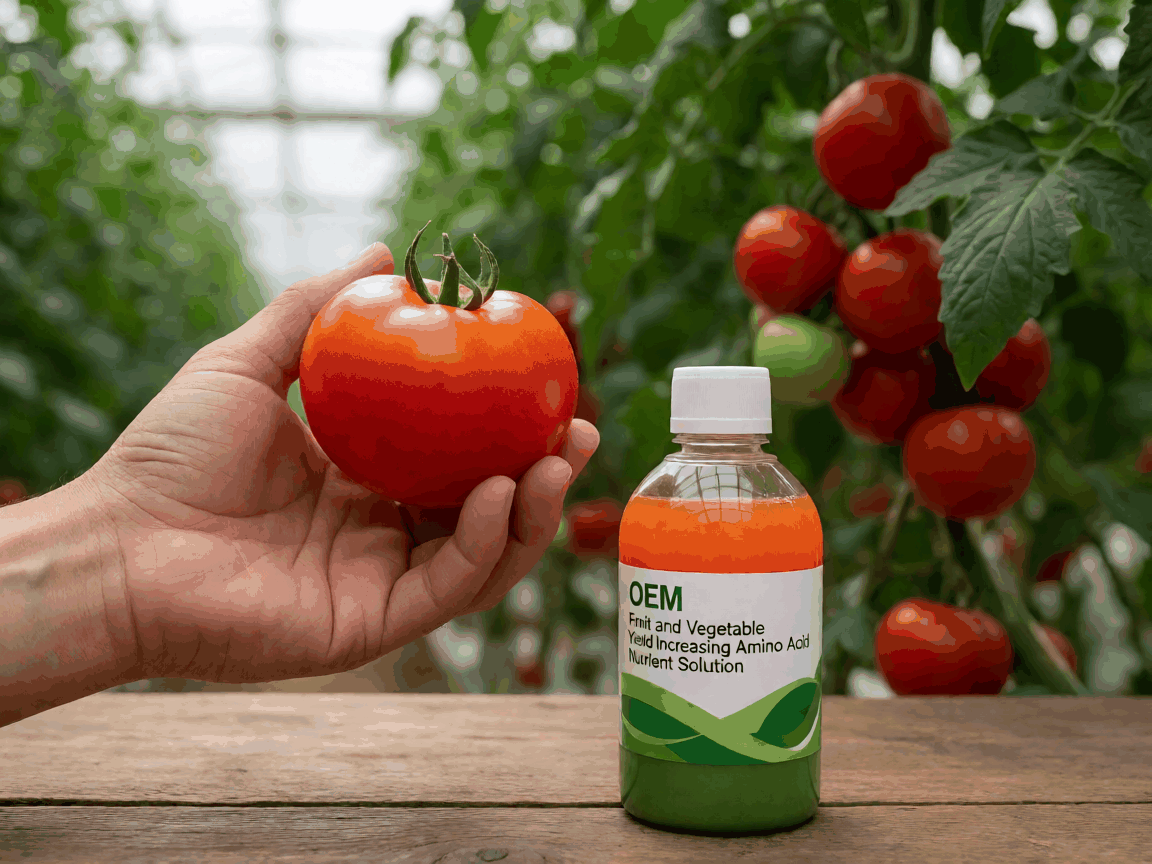
oem fruit and vegetable yield increasing amino acid nutrient solution: What Buyers Should Check Before Ordering
The main trade-off sits between amino acid source consistency and tank-mix stability. Fermentation-derived L-amino acid profiles hold 92–95 % free amino acid content but cost 18–22 % more per litre than acid-hydrolysed blends; the latter often carry 3–5 % D-isomers and chloride residues that trigger phytotoxicity on sensitive cucurbits above 3 L/ha. Buyers specifying private-label fertigation programs for export-grade tomatoes or stone fruit should lock the hydrolysis route before artwork approval — switching sources mid-season invalidates residue trials and forces re-registration.
How It Is Built and What That Changes
Cheaper stock options fail at the worst point in the season — during fruit set when calcium demand spikes and tank mixes include three or more partners. Enzymatic hydrolysis at 50–55 °C preserves peptide chains that chelate Ca²⁺ and Mg²⁺ without precipitating carbonates; acid hydrolysis at 110 °C destroys those chains and leaves free chloride that competes with potassium uptake. A 200 L batch reactor running enzymatic cycles yields 1,800 L of 500 g/L amino acid concentrate per shift; acid hydrolysis doubles throughput but adds a downstream ion-exchange step to strip chloride, adding €0.12/L variable cost.
Tooling amortisation decides the minimum viable order. The enzymatic line requires a dedicated 5 m³ fermenter, ceramic membrane filtration, and low-temperature vacuum concentration — €420 k capex that spreads to €0.08/L at 50 kL annual volume but drops to €0.02/L at 200 kL. Acid hydrolysis uses standard glass-lined reactors already owned for NPK suspension production; changeover cost is a weekend cleanout and €15 k for resin columns. Private-label buyers ordering below 20 kL/year will absorb the enzymatic premium unless they co-invest in a campaign run with two other brands sharing the fermenter schedule.
Comparing Two Standard Configurations
Enzymatic L-Amino Acid Base (Grade E)
Free amino acids: 500–520 g/L (94 % L-isomer)
Chloride: < 0.3 % w/w
pH (1 % sol.): 5.8–6.2
Tank-mix window: Compatible with Ca(NO₃)₂, MgSO₄, EDTA chelates, most fungicides
Shelf life (25 °C): 24 months in opaque HDPE
Acid-Hydrolysed Blend (Grade A)
Free amino acids: 420–450 g/L (88–90 % L-isomer)
Chloride: 2.5–3.5 % w/w
pH (1 % sol.): 3.5–4.0
Tank-mix window: Incompatible with calcium nitrate above 1.5 L/ha; precipitates phosphates
Shelf life (25 °C): 18 months; darkening after 12 months
Grade E supports foliar rates up to 5 L/ha on strawberry and table grape without leaf burn; Grade A is limited to 2 L/ha on the same crops. For soil drench on processing tomato, both grades perform similarly at 15–20 L/ha, making Grade A the margin choice if chloride buildup in the rootzone is managed by leaching fractions > 0.25.
Who Uses It and Where It Matters
Distributors supplying greenhouse clusters in Almería and Brabant specify Grade E for their private-label "fruit finish" lines — 2–3 applications at colour break reduce cracking incidence by 18–22 % versus standard NPK alone, and the low chloride keeps EC drift under 0.3 mS/cm in recirculating systems. Open-field melon growers in Murcia and Puglia run Grade A at 10 L/ha pre-bloom and 15 L/ha fruit set; the chloride load is diluted by 400 mm seasonal irrigation, and the €0.45/L saving on 500 ha translates to €225 k/season.
Brand product managers launching "organic-compliant" ranges in Northern Europe need Grade E with plant-origin certification (non-GMO corn gluten feedstock) and heavy metals < 10 ppm Pb/Cd/As combined. The same formulation sold into conventional channels can use feather-meal hydrolysate — 30 % lower raw material cost — but the certificate of analysis must declare animal origin for retailers requiring vegan claims. One SKU cannot serve both shelves without dual labelling and separate batch records.
Inspection Items and Test Methods
| Parameter | Method | Acceptance Range (Grade E) | Acceptance Range (Grade A) |
|---|---|---|---|
| Total free amino acids | HPLC post-derivatisation (OPA/FMOC) | 500–520 g/L | 420–450 g/L |
| L/D isomer ratio | Chiral HPLC | ≥ 94 % L-form | 88–90 % L-form |
| Chloride content | Ion chromatography / Mohr titration | < 3 g/L | 25–35 g/L |
| pH (1 % aqueous) | Potentiometric | 5.8–6.2 | 3.5–4.0 |
| Density at 20 °C | Oscillating U-tube | 1.22–1.24 g/mL | 1.18–1.20 g/mL |
| Heavy metals (Pb+Cd+As) | ICP-MS after microwave digestion | ≤ 10 mg/kg total | ≤ 20 mg/kg total |
| Microbial load | Plate count (30 °C, 72 h) | < 100 CFU/mL | < 500 CFU/mL |
| Jar test compatibility | Visual + turbidity at 1 h / 24 h | No precipitate with Ca(NO₃)₂ 200 kg/1000 L | Precipitate > 5 mL/100 mL at same test |
Accelerated ageing at 40 °C / 75 % RH for 8 weeks simulates 18 months real-time; Grade E must retain ≥ 90 % initial amino acid content and < 0.5 ΔE colour shift. Grade A typically loses 12–15 % amino acids via Maillard reactions and darkens 2.5 ΔE — acceptable for soil application but a reject for foliar programmes where leaf staining triggers retailer complaints.
Packing, Marking and Freight Configuration
Standard fill: 1,000 L IBC (UN 3082 not required — non-hazardous) with DN50 butterfly valve and 150 µm vent filter. Palletisation: 4 IBCs per 1200×1000 mm Euro pallet, stretch-wrapped, corner boards, max stack 1+1 for sea freight. Gross weight per IBC: 1,240 kg (Grade E) / 1,200 kg (Grade A). A 20 ft container takes 20 IBCs (20,000 L) at 24.8 t — under the 26.5 t payload limit. For air freight consolidation, 200 L HDPE drums (UN 1H1/Y1.4/150) on 4-drum pallets; 80 drums per 40 ft HC container.
Private-label marking requires batch code, manufacture date, net weight, density at 20 °C, and hazard pictograms only if chloride > 5 % (Grade A drums need "Corrosive to metals" GHS05). Artwork lead time: 10 working days for digital proof, 15 days for plate production if flexo printing on IBC sleeves. Minimum print run per SKU: 50 IBC sleeves or 200 drum labels. Buyers ordering mixed Grade E/A in the same container must segregate paperwork — customs HS 3105.90 covers both, but certificate of analysis per batch is mandatory for EU fertilizer regulation (EU) 2019/1009 Annex I.4.1 compliance.
Next Step: Specification Review
Send your target crop, application method (fertigation / foliar / drench), tank-mix partners, and annual volume split by grade. We will return a comparative cost model including tooling amortisation, stability protocol, and label compliance checklist within two business days.
Request specification review


