oem amino acid fertilizer for agriculture export suppliers - Bulk Supply and Specification Guide
Scope of Supply and Physical Form
| Parameter | Typical Range | Unit | Notes |
|---|---|---|---|
| Form | Granular / Liquid concentrate | — | Granules 2–4 mm; liquid 30–40 % w/w solids |
| Amino acid content | 12–18 | % w/w | Measured by HPLC after acid hydrolysis |
| Total nitrogen | 8–12 | % w/w | Kjeldahl method |
| pH (1 % solution) | 5.5–6.5 | — | Stable in this window |
| Moisture | ≤2.0 | % w/w | Critical for caking resistance |
| Bulk density | 550–650 | kg m⁻³ | Granular only |
| Solubility | ≥250 | g L⁻¹ | Liquid concentrate at 20 °C |
| Packaging | 25 kg bag / 1000 kg bulk bag / 20 L drum | — | Export‑grade woven PP with liner |
| Shelf life | 24 | months | Stored ≤30 °C, ≤60 % RH |
Granular grades dominate bulk‑spread programs because they survive mechanical handling and long sea voyages without generating dust. Liquid concentrates reduce freight volume but demand airtight drums and a strict cold‑chain for the first 30 days after dispatch.
Design Constraints Behind the Specification
Every export lot must meet the importing country’s heavy‑metal ceiling (Cd < 10 mg kg⁻¹, Pb < 50 mg kg⁻¹) while keeping free‑amino‑acid ratios within ±5 % of the label claim. A drift beyond that window triggers phytotoxicity on seedlings, a complaint that arrives as a rejected shipment rather than a lab report.
Critical Specification Rule
If the declared amino‑acid profile shifts more than five percent, the batch is quarantined and re‑processed; no partial release is permitted.
Caking is the second most frequent claim. Moisture above 2 % combined with a bulk density under 560 kg m⁻³ creates bridges inside 25 kg bags, forcing the buyer to re‑screen before application.
Option Comparison by Usage Level
Granular High‑Amino (12‑18 % AA)
Best for broad‑acre cereal and oilseed programs where spreader uniformity matters. The 2–4 mm granule survives pneumatic conveyors and delivers a slow‑release nitrogen curve that matches a 60‑day crop cycle.
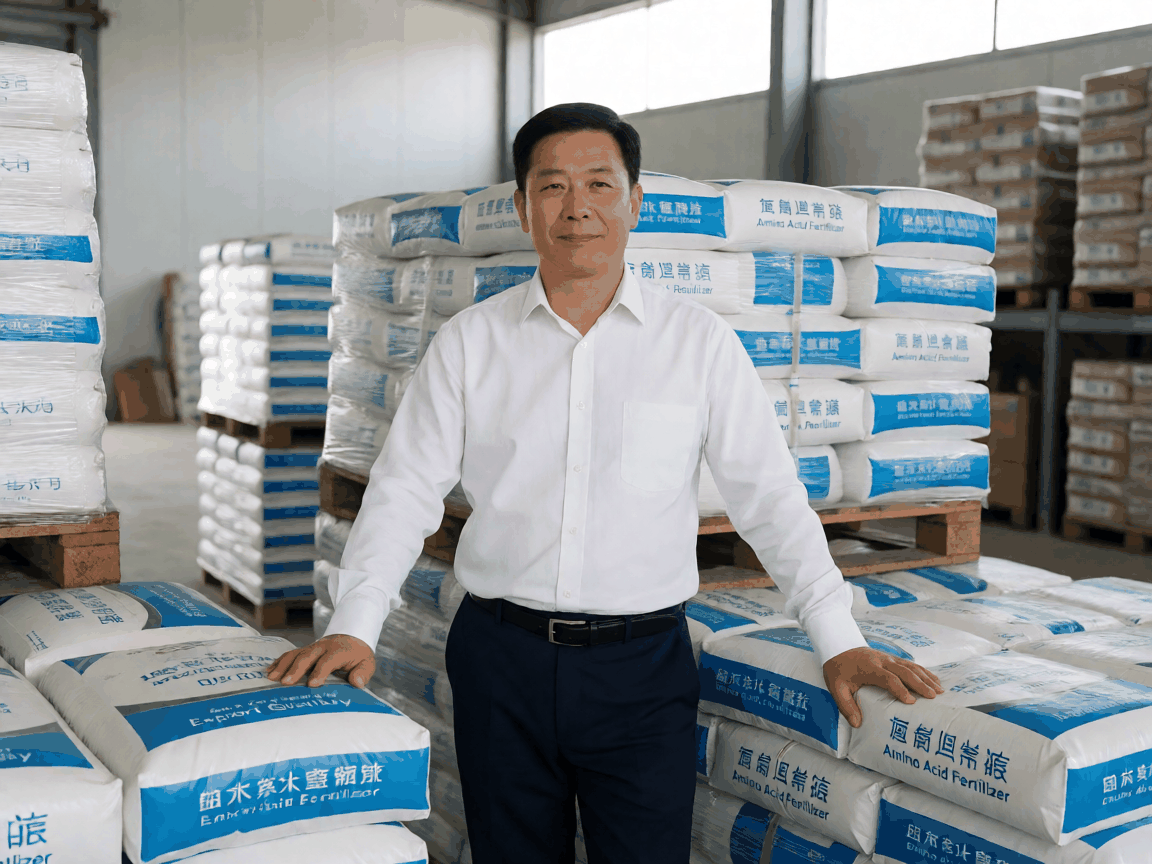
Typical MOQ 20 t; lead time 4 weeks after artwork approval.
Liquid Concentrate (30‑40 % solids)
Chosen for high‑value horticulture and fertigation systems. The solution stays clear at 20 °C, but any temperature excursion above 35 °C accelerates hydrolysis, raising free‑ammonia risk.
Typical MOQ 10 t; lead time 3 weeks, drum availability permitting.
Granules win on freight density (≈1.2 t m⁻³) and shelf stability; liquids win on application precision and rapid nutrient uptake. The decision hinges on whether the end‑user operates a spreader or a drip line.
Matching the Product to the Buyer's Need
A buyer targeting EU organic certification must specify a fermented‑protein source with a certified‑organic amino‑acid profile; the same buyer sourcing for a conventional Asian market can accept a hydrolysed‑casein base at lower cost.
| Durability Factor | Granular | Liquid | Decision Rule |
|---|---|---|---|
| Caking resistance | High (≤2 % moisture) | N/A | Select granular if storage >3 months |
| Dust generation | Low (coated granules) | None | Liquid preferred for enclosed fertigation |
| Shelf life at 30 °C | 24 months | 18 months (requires cool storage) | Granular for long‑haul sea freight |
| Phytotoxicity risk | Low if AA profile met | Higher if temperature abused | Enforce cold‑chain for liquid |
Use the table to align the physical form with the logistics chain and the crop’s sensitivity window.
OEM and ODM Programme Structure
Private‑label runs start at 15 t for granular and 8 t for liquid. Artwork files (AI, 300 dpi, CMYK) must be supplied 10 working days before the scheduled blend; any revision after that point adds a week to the slot.
Custom amino‑acid blends (e.g., enriched lysine + methionine) require a pilot batch of 500 kg for analytical verification; the pilot cost is credited against the first full order.
Quality Control and Batch Consistency
Each production lot undergoes: (1) raw‑material certificate review, (2) in‑process moisture and pH checks every 2 t, (3) final composite sample analysed for total N, amino‑acid profile by HPLC, heavy metals by ICP‑MS, and sieve distribution for granules. A Certificate of Analysis accompanies every shipment; any parameter outside specification triggers a hold until re‑work or rejection.
Statistical process control charts track batch‑to‑batch nitrogen variance; the target Cpk is ≥1.33 for total N and ≥1.0 for each declared amino acid.
Volume Planning and Lead Time
Standard granular stock (12 % AA) is held at 500 t in the bonded warehouse; dispatch can occur within 5 business days of purchase order confirmation. Custom formulations follow a 3‑week production window after pilot approval, plus 7‑10 days for ocean freight to major Asian ports.
Peak season (March‑May) adds two weeks to the schedule; early‑order commitments before January secure the preferred slot.
Setup, Use and Replacement Parts
Store bags on pallets, off the floor, under a ventilated cover; avoid direct sunlight. For liquid drums, keep temperature between 5‑25 °C and rotate stock every 6 months to prevent stratification.
If caking appears, pass the affected bags through a low‑speed roller mill (≤30 rpm) to restore flowability; the process does not alter nutrient content. Drum liners are single‑use; replace after each fill to avoid cross‑contamination.
Ready to Review Specifications?
Submit your formulation targets and packaging requirements for a detailed quotation.
Request Specification Review


